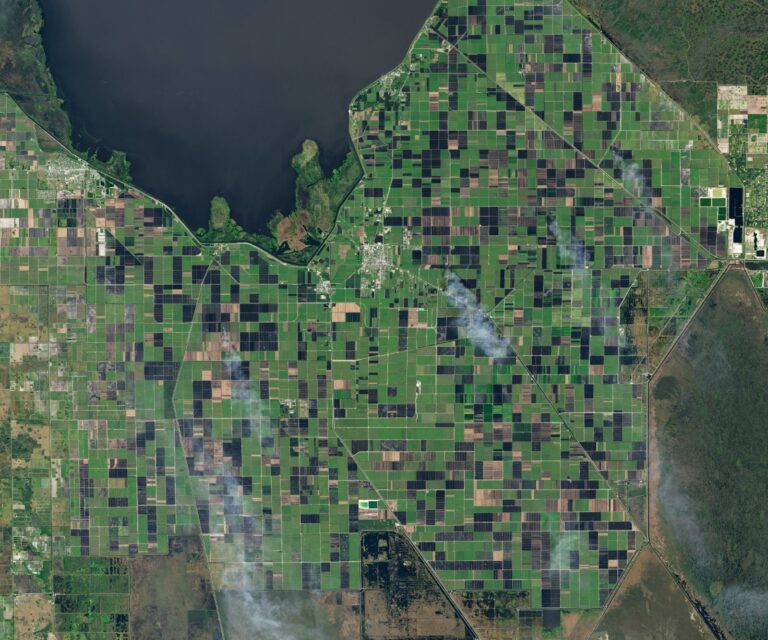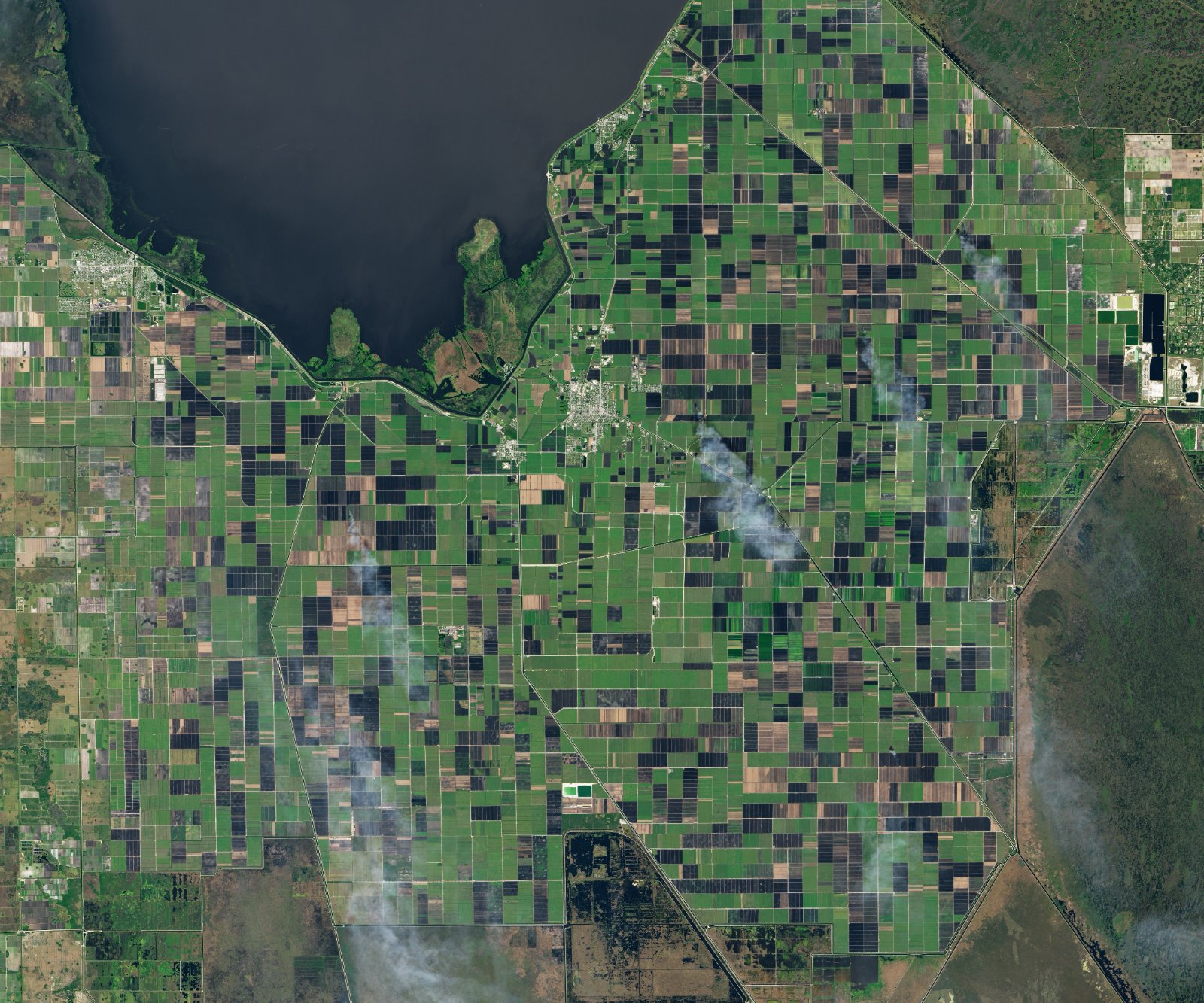
Image: NASA Earth Observatory (Lauren Dauphin) using Landsat 8 data from USGS, January 5, 2021. Public domain (NASA).
Quick Answer: USDA’s November 17, 2026 outlook forecasts Florida’s 2026-27 sugar output at 1.757 million short tons, raw value, down from 1.957 million a year earlier and the lowest since 2010-11. Mealybugs, a dry growing season and last winter’s freezes cut cane yields to 39.5 tons per acre. Palm Beach County, which holds about 70% of Florida’s cane acreage, absorbs most of the impact.
The cane harvest in western Palm Beach County is well underway, and this year’s crop is coming in smaller than any in more than a decade. The U.S. Department of Agriculture’s Economic Research Service (ERS) cut its Florida forecast again in the November 2026 Sugar and Sweeteners Outlook, released November 17. The Glades economy, from Belle Glade and South Bay to Pahokee and Canal Point, depends heavily on the crop.
How much sugar will Florida produce in the 2026-27 season?
ERS now expects Florida to produce 1,757,000 short tons, raw value (STRV), of sugar in fiscal 2026-27. That is 61,000 tons below its October estimate and about 200,000 tons, or roughly 10%, below the 1,957,000 tons estimated for 2025-26. ERS called it the lowest Florida output since 2010-11.
Both acreage and yield fell. In October, USDA projected 395,000 harvested acres and 1.819 million tons of sugar. In November, it projected 384,000 acres harvested for sugar. The National Agricultural Statistics Service (NASS) cut its cane yield estimate from 39.8 to 39.5 tons per acre, the lowest since 2014-15. ERS named three causes: mealybug infestation, drought during the growing season, and the February freeze.
| Florida sugarcane (fiscal year) | 2025-26 estimate | 2026-27 forecast | Change |
|---|---|---|---|
| Area harvested for sugar | 399,000 acres | 384,000 acres | -15,000 acres |
| Cane yield | 41.9 tons/acre | 39.5 tons/acre | -2.4 tons/acre |
| Cane produced for sugar | 16.718 million tons | 15.160 million tons | -1.558 million tons |
| Sugar recovery rate | 11.7% | 11.6% | -0.1 point |
| Sugar production (STRV) | 1,957,000 | 1,757,000 | -200,000 |
Source: USDA ERS, Sugar and Sweeteners Outlook, November 2026 (SSS-M-459).
The decline follows a strong year: 2025-26 output was up from 1.932 million tons in 2024-25, and ERS estimated U.S. cane sugar production that year at a record 4.242 million tons.
Why does Palm Beach County matter so much to Florida sugar?
Sugarcane in Florida is grown mostly in Palm Beach County. The UF/IFAS crop profile for Florida sugarcane says the county accounts for about 70% of the state’s cane acreage and 75% of its tonnage. The rest is grown in Hendry, Glades, Highlands and Martin counties. According to the same profile, four mills in South Florida crush all of the state’s cane, and the harvest runs from October through May.
The Palm Beach County Cooperative Extension says about 440,000 acres of sugarcane are planted in the Everglades Agricultural Area, mostly along the southern half of Lake Okeechobee. About 80% is grown on organic muck soils. It says Florida supplies about 20% of all sugar consumed in the U.S.
Sugar is a large reason Palm Beach is Florida’s leading agricultural county. The 2022 Census of Agriculture counted 1,368 farms covering 460,575 acres in the county, with $1.251 billion in agricultural sales. That ranked first in Florida and 33rd among all U.S. counties. Crops made up 97% of the total, and the county ranked 15th nationally in crop sales. Sugarcane was the top crop by area, with 236,659 acres harvested for sugar or seed.
| Palm Beach County agriculture key facts | Figure | Source |
|---|---|---|
| Farms | 1,368 | 2022 Census of Agriculture |
| Land in farms | 460,575 acres | 2022 Census of Agriculture |
| Market value of products sold | $1.251 billion (1st in Florida) | 2022 Census of Agriculture |
| Sugarcane acres (sugar or seed) | 236,659 | 2022 Census of Agriculture |
| County share of Florida cane acreage / tonnage | About 70% / 75% | UF/IFAS crop profile |
| Sugar industry employment (statewide) | Over 14,000 | PBC Cooperative Extension |
How much did last winter’s freezes cost the sugar industry?
The Florida Department of Agriculture and Consumer Services (FDACS) published a freeze damage report in February 2026. It covered two cold events: Winter Storm Ezra, from December 30, 2025 to January 1, 2026, and Winter Storm Gianna, from January 26 to February 4, 2026. The department estimated that 401,000 acres of sugarcane were affected.
FDACS put the annual value of Florida sugarcane at $1.646 billion and estimated a 35% production loss, or $576.1 million, in the 2025-26 season. It projected another $576.1 million in losses over the next three crops: $329.2 million in 2027, $164.6 million in 2028 and $82.3 million in 2029. Total projected losses come to about $1.15 billion.
Because cane is harvested from the same planting for several years, freeze damage carries into later crops. The UF/IFAS profile says growers plant about 120,000 acres a year, mostly from September through December, and that about 95% of planting is done by hand.
Who are the main sugar growers and mills in the Glades?
Three companies receive Florida’s share of the federal cane sugar marketing allotment. In its September 30, 2026 announcement, the USDA Farm Service Agency (FSA) gave Florida an initial fiscal 2027 cane allotment of 2,721,800 STRV and divided it among those three processors.
| Company snapshot | Base | Reported scale | FY2027 initial allocation (STRV) |
|---|---|---|---|
| Florida Crystals | Okeelanta mill, refinery and 140 MW cogeneration plant, South Bay | 190,000 acres in western Palm Beach County rotating cane, rice and vegetables (2023) | 1,120,637 |
| U.S. Sugar Corp. | Clewiston (Hendry County) | More than 250,000 acres; nearly 3,000 employees | 1,111,552 |
| Sugar Cane Growers Cooperative of Florida | Belle Glade | About 70,000 member acres; more than 350,000 tons raw sugar a year | 489,612 |
Sources: USDA FSA fiscal 2027 sugar announcement; company materials; U.S. EPA Title V permit documents; WPTV.
What does Florida Crystals operate in South Bay?
Florida Crystals has the largest Florida allocation. An April 2025 Title V air permit renewal document from the U.S. Environmental Protection Agency describes the Okeelanta Corporation complex at 8001 U.S. Highway 27 South in South Bay. The site includes a sugar mill, a sugar refinery, packaging and transshipment operations, and a cogeneration plant run by New Hope Power Company. The 140-megawatt plant burns bagasse, the fiber left after cane is crushed, plus wood chips, supplying steam to the mill and selling power to the grid. WPTV reported in 2023 that the company also runs the Sem Chi Rice Mill in Belle Glade.
How large is U.S. Sugar?
Clewiston-based U.S. Sugar, founded in 1931, also runs a 300-mile railroad and a refinery in Savannah, Georgia. In a June 2026 post, the company cited a Texas A&M analysis estimating that it supports about 19,000 jobs and $4.7 billion in annual economic activity in Florida. The company also says it is the largest private taxpayer in Clewiston and in Hendry County.
What is the Sugar Cane Growers Cooperative?
The Belle Glade cooperative serves small and medium-sized member farms and marked its 60th crop in 2022.
How does the federal sugar program support Glades growers?
The federal sugar program uses price-support loans, limits on how much sugar processors can sell domestically, and import quotas. Congress raised the support level in the 2025 budget reconciliation law, which President Trump signed on July 4, 2025. The American Farm Bureau Federation reports that the law set the raw cane sugar loan rate at 24 cents per pound for the 2025 through 2031 crop years.
For fiscal 2027, which covers the 2026 crop, FSA set regional raw cane loan rates of 22.84 cents per pound in Florida and 25.07 cents in Louisiana. The overall allotment quantity, the total amount domestic processors may sell, is 10,574,850 STRV. That is 85% of estimated U.S. consumption of 12,441,000 tons. Beet processors received 54.35% of the total and cane processors received 45.65%, or 4,827,419 tons. Florida’s cane allotment of 2,721,800 tons is larger than the 1.757 million tons ERS now expects the state to produce. The allotment does not limit this year’s sales; the crop does.
What is happening to national sugar supply and prices?
The November outlook projects U.S. sugar production of 8.520 million STRV in 2026-27, down 248,000 tons from October. Beet sugar accounts for 4.552 million tons and cane sugar for 3.968 million. ERS forecasts imports of 3.430 million tons and ending stocks of 1.723 million tons. That puts the stocks-to-use ratio at 13.9%, down from 17.8% estimated for 2025-26 in the October report.
Prices have risen. ERS cited Sosland Publishing’s Sweetener Report, which quoted refined beet sugar at 60 to 63 cents per pound in the first two weeks of November, 14 to 15 cents higher than a year earlier.
ERS projects Mexico’s 2026-27 exports to the United States at 1.017 million metric tons, with the Commerce Department recalculating that limit in December 2026 and March 2027. The next ERS outlook is due December 16, 2026.
What are the rules for burning sugar cane before harvest?
Most Florida cane is burned before harvest to remove leaves before the stalks are cut. Smoke from these burns is the industry’s most visible effect on Glades towns. The Florida Forest Service, part of FDACS, authorizes each burn based on weather and wind direction. State restrictions adopted in 1991 prohibit burning when winds would carry smoke east toward the coastal suburbs. According to a 2025 Inside Climate News report published by WUSF, critics say this pattern concentrates smoke over inland communities such as Belle Glade, Pahokee and South Bay. Burns run from fall into spring.
On October 1, 2019, the agriculture commissioner at the time, Nikki Fried, announced statewide changes to prescribed burning rules. The changes banned burning at night and before 11 a.m. on foggy mornings. They required an 80-acre buffer between wildlands and cane fields on dry, windy days, cut the deadline for suppressing muck fires from 96 to 72 hours, and required a review of an air-quality index and weather models before any burn is authorized.
Legal pressure on burning has also changed. The 2025 report says a 2019 federal class-action suit brought on behalf of Glades residents was dropped three years later, after the Legislature changed state law to protect the sugar industry from legal challenges over air pollution. In 2023, the Sierra Club asked the EPA and USDA to investigate the burns under Title VI of the Civil Rights Act, and the report says it received no response. Grower Rick Roth of Roth Farms told the outlet that the industry has tested green harvesting, which leaves leaves on the field instead of burning them, for several years, and that “the percentage is going up.”
What does the sugar economy mean for Belle Glade, Pahokee and South Bay?
Data USA, which uses Census Bureau American Community Survey figures, reports that Belle Glade had 16,972 residents in 2024, a median household income of $48,001 and a poverty rate of 27.3%. Agriculture, forestry, fishing and hunting employed 820 Belle Glade residents, the second-largest group after educational services. Pahokee had 5,609 residents, a median household income of $53,359 and a poverty rate of 32.1%.
The county Extension office says the Florida sugar industry has a total direct and indirect economic value above $2 billion. UF/IFAS notes that about 95% of cane planting is still done by hand. Mill, rail, trucking and equipment jobs depend on how many tons of cane are crushed.
That makes this year’s smaller crop a local issue as well as a commodity story. At the forecast yield, Florida mills would process about 1.56 million fewer tons of cane than in 2025-26. And because FDACS expects freeze damage to keep reducing yields through 2029, the region’s farm income may take several seasons to recover.
Frequently Asked Questions
How much sugar will Florida produce in 2026-27?
USDA ERS forecast 1,757,000 short tons, raw value, in its November 17, 2026 outlook. That is down from 1,957,000 tons in 2025-26 and the lowest since 2010-11.
Why is the Florida sugarcane crop smaller this year?
ERS cited mealybug infestation, drought during the growing season and the February 2026 freeze. Together they reduced the yield forecast to 39.5 tons per acre, and harvested area fell to 384,000 acres.
How much of Florida’s sugarcane is grown in Palm Beach County?
UF/IFAS says the county accounts for about 70% of Florida’s cane acreage and 75% of its tonnage. The 2022 Census of Agriculture counted 236,659 acres of sugarcane in the county.
What is the federal loan rate for Florida raw cane sugar?
FSA set the fiscal 2027 Florida raw cane loan rate at 22.84 cents per pound. The 2025 reconciliation law set the national raw cane rate at 24 cents per pound for the 2025 through 2031 crop years.
Sources and Further Reading
- Sugar and Sweeteners Outlook: November 2026 (SSS-M-459) — USDA Economic Research Service
- Sugar and Sweeteners Outlook: October 2026 (SSS-M-458) — USDA Economic Research Service
- USDA Announces Fiscal Year 2027 Sugar Loan Rates, Allotment, Marketing Allocations — USDA Farm Service Agency
- 2026 Freeze Report — Florida Department of Agriculture and Consumer Services
- 2022 Census of Agriculture County Profile: Palm Beach County, Florida — USDA National Agricultural Statistics Service
- Florida Crop/Pest Profile: Sugarcane (PI207) — UF/IFAS Extension
- Agriculture: Sugarcane — Palm Beach County Cooperative Extension
- One Big Beautiful Bill Act: Final Agricultural Provisions — American Farm Bureau Federation
- Okeelanta Corporation Title V Permit Renewal Statement of Basis — U.S. Environmental Protection Agency
- Florida rules concentrate toxic smoke in underserved communities — Inside Climate News via WUSF
- Florida Agriculture Commissioner Nikki Fried adds restrictions to sugar industry burning — CBS News Miami
- How does agriculture drive jobs and opportunity in South Florida communities; Pre-Harvest Celebration at U.S. Sugar — U.S. Sugar
- Celebrating 60 Years of Innovation — Sugar Cane Growers Cooperative of Florida
- Florida Crystals expands renewable energy production — WPTV
- Belle Glade, FL and Pahokee, FL profiles — Data USA (U.S. Census Bureau ACS data)
- Smoking Sugar Fields in South Florida — NASA Earth Observatory (featured image)
About the Author