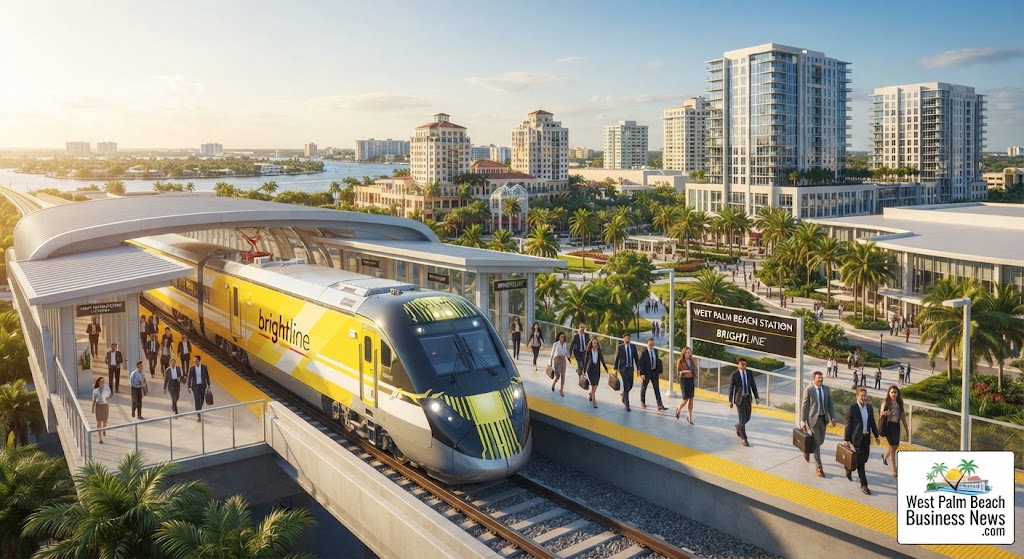
How Brightline Rail Service Helps West Palm Beach Businesses (2026)
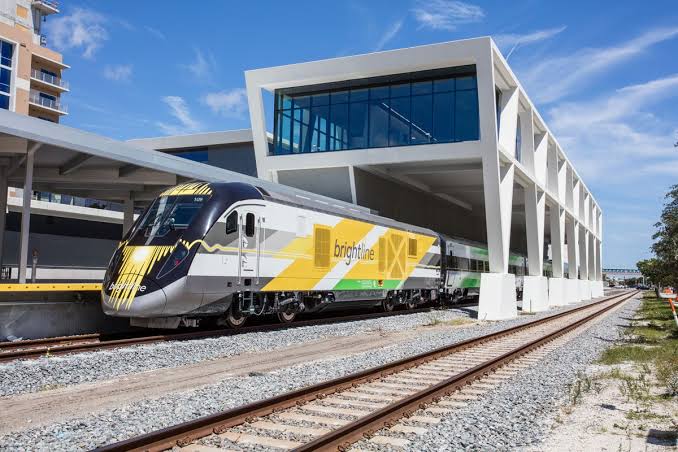
Quick Answer: Brightline — the only privately owned intercity passenger railroad in the United States — helps West Palm Beach businesses in five concrete ways: it expands the talent pool by making Miami, Fort Lauderdale, Boca Raton, and Aventura commutable to downtown WPB in about an hour or less; it powers corporate travel, with more than 135 companies under contract through the Brightline for Business program; it fuels the “Wall Street South” relocation wave that has filled the city’s new office towers; it drives customers into downtown, where the station sits steps from CityPlace, the convention center, and Clematis Street; and it anchors real-estate value around the station district. Service began in West Palm Beach in January 2018 and reached Orlando in September 2023 — though businesses should also understand Brightline’s well-publicized financial struggles, covered honestly below.
Brightline & West Palm Beach: The Essentials
| Fact | Detail |
|---|---|
| WPB station location | Downtown, at Evernia St. — minutes from CityPlace, the convention center, and the Flagler Financial District |
| Service launched | January 2018 (Miami–WPB corridor); Orlando service September 2023 |
| Travel time to Miami | Roughly one hour |
| Corporate program | Brightline for Business — 135+ companies under contract |
| Commuter product | Fixed-rate passes reintroduced May 2025; ridership growing monthly |
| System ridership | ~3 million trips booked in fiscal 2024; South Florida ridership up 25% year-over-year in January 2026 |
Why Does a Train Matter So Much to West Palm Beach Businesses?
Because West Palm Beach’s biggest economic constraint has never been demand — it’s been geography. The city sits 70 miles north of Miami at the top of a metro area strangled by I-95 congestion, which historically made it hard for WPB employers to hire from the region’s deepest talent pools and hard for Miami money and clients to treat West Palm as a same-day destination. Brightline dissolved that constraint. When a Miami meeting became a one-hour train ride with Wi-Fi instead of a white-knuckle two-hour drive, West Palm Beach effectively joined the South Florida business market as a full participant — and the results now show up across the local economy.
A Dramatically Bigger Talent Pool
The most valuable thing Brightline gives a West Palm Beach employer is access to workers who don’t live in Palm Beach County. With stations in Boca Raton, Fort Lauderdale, Aventura, and Miami, a company headquartered near the WPB station can realistically recruit across all of South Florida — a labor market of millions — rather than only its home county. Brightline has leaned into this with fixed-rate commuter passes, reintroduced in May 2025, which grew from roughly 560 passholders taking about 8,900 rides in their first month to steadily higher numbers since, and the company reported South Florida short-haul ridership up 25% year-over-year by January 2026 as commuters returned.
This flows both directions. West Palm Beach residents can take jobs downtown at firms whose clients sit in Miami; Broward-based analysts can accept offers from WPB financial firms without relocating. In a county where housing costs have squeezed mid-career professionals, the train is quietly functioning as a workforce-housing policy: employees live where they can afford and commute to where the jobs are.
Corporate Travel and the Client Pipeline
Brightline built a formal product for this: Brightline for Business, its corporate travel program, which had more than 135 companies under contract as of late 2025, with discounted fares, centralized billing, and travel management. The company has also signed with a global reservation network to plug into corporate travel management systems — meaning WPB trips increasingly get booked the same way flights do.
For the professional-services economy — the law firms, banks, wealth managers, and consultants of the Flagler Financial District — this changes the rhythm of business. A Miami client meeting no longer consumes a full day. A deal team can split across offices in two cities. Notably, when Brightline restructured its schedules in October 2025, it increased Miami–West Palm Beach frequencies even while trimming Orlando runs — a signal that the WPB business corridor is among its strongest markets.
📌 Brian’s Take
Here’s the connection most coverage misses: Brightline and “Wall Street South” are the same story. When Goldman Sachs, BlackRock, and dozens of hedge funds chose West Palm Beach, the pitch wasn’t just zero income tax — it was that partners could reach Miami clients and Fort Lauderdale’s airport without a car. The train de-risked the relocation decision for every firm that followed, and those firms filled the Related Ross office towers built deliberately near the station. If you run a WPB business today, my practical advice is simple: put Brightline for Business in your toolkit (135 companies already have), advertise “steps from Brightline” in every job posting, and treat the commuter pass as a recruiting benefit. It’s the cheapest geographic expansion you’ll ever buy.
Foot Traffic for Downtown Retail, Restaurants, and Hotels
The West Palm Beach station wasn’t dropped at the edge of town; it sits in the middle of the city’s spending zone. Arriving passengers walk out into the CityPlace/Rosemary Square district — 30-plus restaurants, shops, and entertainment — and are five minutes from the convention center and a short stroll from Clematis Street. Every train delivers customers with no parking to find and no designated driver to appoint, which is exactly the demographic downtown’s restaurants, bars, and hotels want.
Events multiply the effect. Brightline runs promotions and shuttles around major South Florida happenings, and marquee West Palm Beach events — the Palm Beach International Boat Show, SunFest, Kravis Center shows — draw attendees who train in from three counties. In 2026, the effect runs southbound too: with seven World Cup matches in Miami beginning June 15, WPB hotels and restaurants can capture visitors who stay locally and ride Brightline to the games. Onboard and in-station spending shows how commercial the ecosystem has become: Brightline’s in-station retail nearly tripled from $1.3 million to $3.7 million in a single year.
Real Estate Value and Transit-Oriented Development
Ask any commercial broker downtown: proximity to the Brightline station is now a line item in office leasing. The city’s new Class A towers — part of roughly 2.8 million square feet completed or underway — cluster within walking distance of the station, and “Brightline-walkable” has become shorthand for premium space. Residential developers make the same calculation, marketing station-district apartments to Miami commuters. For business owners who own their real estate, the train has effectively added an appreciating asset to their balance sheets.
The Honest Caveat: Brightline’s Finances
A business article owes readers the full picture: Brightline the service is thriving in the WPB corridor, but Brightline the company is financially strained. It has never turned an operational profit, posted a $549 million net loss in fiscal 2024 despite doubling revenue, has absorbed repeated credit downgrades deep into junk territory, and in 2025–2026 disclosed going-concern warnings while pursuing new debt, equity partners, and asset sales; one rating agency has flagged default risk as early as 2027 if trends don’t improve. What does that mean for WPB businesses? Almost certainly not an end to service — the railroad’s assets, ridership growth, and strategic value make restructuring far likelier than shutdown — but possibly higher fares, schedule changes, or new ownership. Businesses building Brightline into their operations should follow the monthly ridership reports the company files publicly and keep contingency plans proportionate.
The Bottom Line
Brightline turned West Palm Beach from the northern edge of South Florida into a connected node at the center of it. The measurable results — 135+ corporate accounts, surging commuter ridership, boosted Miami–WPB frequencies, station-district development, and the Wall Street South migration it helped enable — add up to one of the clearest examples in America of private rail creating private-sector value.
📌 Brian’s Take
The financial-trouble headlines scare people, so let me frame the risk properly: the trains are full of exactly the riders WPB businesses need — the question is who ultimately owns the railroad, not whether it runs. Infrastructure with 3 million annual trips and growing corridor demand doesn’t disappear; it gets restructured, recapitalized, or acquired. Meanwhile, every month you wait to leverage it, a competitor is recruiting Broward talent, hosting Miami clients, and leasing space next to the station. My bottom line for WPB business owners: build Brightline into your hiring, your client experience, and your location strategy now — and simply keep one eye on the bondholder news.
References and Sources
- Brightline — Monthly Revenue and Ridership Reports (October 2025, December 2024, February 2026): Brightline for Business contracts, commuter pass growth, schedule changes, in-station retail. https://www.gobrightline.com
- WLRN / WUWF — “Ridership and revenue is growing for Brightline, but financial worries persist” (February 2026). https://www.wlrn.org
- Trains.com — “Brightline confronts cash crunch even as it gains riders, revenue in Florida” (January 2026). https://www.trains.com
- Wikipedia — Brightline (service history, ridership milestones, fiscal 2024 results, credit actions). https://en.wikipedia.org/wiki/Brightline
- Business Development Board of Palm Beach County — Wall Street South and transportation advantages. https://bdb.org
Figures reflect public reports as of mid-2026; Brightline’s schedules, pricing, and financial situation are evolving — confirm current details at gobrightline.com.
About the Author