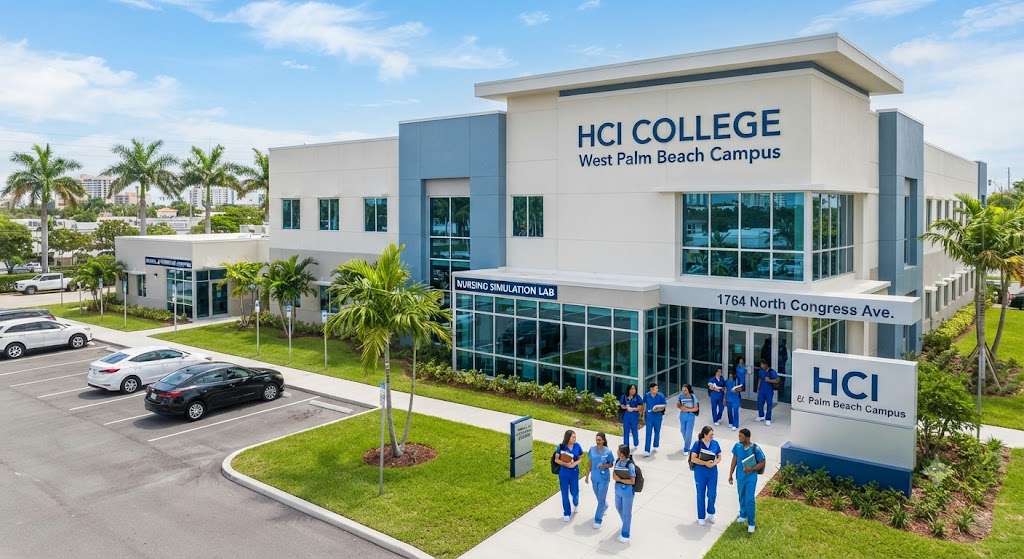
HCI College West Palm Beach: A Complete Guide to the Nursing & Healthcare Education Campus (2026)
Quick Answer: HCI College’s West Palm Beach campus, located at 1764 North Congress Ave., West Palm Beach, FL 33409 (corner of Congress Ave. and Westgate Ave.), is a career-focused healthcare college offering four core medical education programs: an Associate Degree in Nursing (ADN) — a 72-credit, ACEN-accredited program completable in as little as 2 years that qualifies graduates to sit for the NCLEX-RN — a 16-month Practical Nursing diploma leading to LPN licensure, a 10-month hybrid Medical Assisting diploma with on-campus CCMA certification testing, and a 10-month hybrid Veterinary Assisting diploma with a 180-hour externship. The college also offers American Heart Association courses. HCI College is accredited by the Accrediting Commission of Career Schools and Colleges (ACCSC) and licensed by Florida’s Commission for Independent Education. Prospective students can reach admissions at (561) 586-0121.
HCI College West Palm Beach Campus: Contact Information
| Address | 1764 North Congress Ave., West Palm Beach, FL 33409 |
| Cross streets | Corner of Congress Ave. and Westgate Ave. |
| Phone | (561) 586-0121 (also 561-471-4010) |
| Admissions hours | Mon–Thurs: 8:30 a.m.–7:00 p.m.; Fri: 8:30 a.m.–4:00 p.m. |
| Website | https://www.hci.edu/location/west-palm-beach |
| Programs offered | Associate Degree in Nursing, Practical Nursing, Medical Assisting, Veterinary Assisting, American Heart Association courses |
What Is HCI College?
HCI College — which grew out of the Health Career Institute — is a private, career-focused healthcare college operating two South Florida campuses: the West Palm Beach campus on North Congress Avenue and a Fort Lauderdale campus on West Cypress Creek Road. Unlike traditional four-year universities, HCI College concentrates exclusively on preparing students for hands-on healthcare careers, with compact, employment-oriented programs, day and evening scheduling built around working adults, and a stated commitment to hands-on learning in labs, simulation environments, and real clinical settings.
The West Palm Beach campus sits in the heart of one of Florida’s most opportunity-rich healthcare markets. Palm Beach County’s hospital systems, physician practices, long-term care facilities, and outpatient clinics are all competing for staff amid a well-documented national nursing shortage — a shortage intensified by retirements, burnout, and an aging population, as HCI’s own published research notes. For students, that translates into a straightforward value proposition: train locally, complete clinicals in the same community where you intend to work, and graduate into a labor market that is actively hiring.
The campus location is genuinely practical. Positioned at the corner of Congress Avenue and Westgate Avenue — minutes from Palm Beach Lakes Boulevard, I-95, and Palm Beach International Airport — it’s reachable from virtually anywhere in central Palm Beach County, from Riviera Beach to Wellington to Lake Worth Beach. Admissions keeps extended hours four days a week (until 7:00 p.m. Monday through Thursday), a small detail that says a lot about the student body: many HCI students are career changers and working parents who tour campuses and complete paperwork after their day jobs end.
📌 Brian’s Take — The Campus in Context
When people think “nursing school in Palm Beach County,” they usually name the big public institutions first. But there’s a real place in this market for a focused career college, and it comes down to two things: speed and schedule. A 16-month LPN diploma or a two-year ADN with evening options serves a student the traditional system often can’t — the 32-year-old CNA who needs to keep earning while she upgrades her license. Don’t evaluate HCI against a university; evaluate it against the cost of waiting. For the right student, time-to-license is the metric that matters most.
HCI College West Palm Beach Programs: Complete Breakdown
The West Palm Beach campus offers four credential programs — one associate degree and three diplomas — plus American Heart Association certification courses. Here is each program in detail.
1. Associate Degree in Nursing (ADN) — Become a Registered Nurse
Credential: Associate Degree in Nursing (ADN) Length: 72 credit hours; completable in as little as 2 years Format: General education courses online; nursing lectures, labs, and clinicals on campus and at clinical sites Leads to: Eligibility to sit for the NCLEX-RN to become a Registered Nurse
The Associate Degree in Nursing is HCI College’s flagship program and the reason most students find their way to the North Congress Avenue campus. It is designed as a direct pipeline to registered nursing: a 72-credit-hour course of study combining online general education with on-campus nursing lecture, laboratory, and clinical instruction, structured so a full-time student can finish in approximately two years.
Accreditation — the detail that matters most: The ADN program at the West Palm Beach campus is accredited by the Accreditation Commission for Education in Nursing (ACEN), the programmatic accreditor for nursing education (the most recent ACEN Board decision for the program is initial accreditation, and the program’s public information is available on the ACEN website). Programmatic accreditation matters enormously in nursing: it is often required for graduates who later want to pursue an RN-to-BSN bridge program, for certain employers (including federal and military healthcare roles), and for eligibility for some tuition-assistance programs. An associate degree from a nursing program without programmatic accreditation can quietly close doors years later; HCI’s ACEN status keeps them open.
What students learn: The curriculum is built around several published program goals. Students learn to apply critical thinking, the nursing process, and evidence-based practice to achieve optimal patient outcomes; to deliver safe, patient-centered care through teamwork and collaboration across the full lifecycle of care, from preventive medicine to end-of-life support; to make culturally competent decisions grounded in communication and mutual respect with patients, families, and interprofessional care teams; to incorporate legal and ethical guidelines and commit to lifelong professional learning; and to use healthcare technology to reduce errors, document care, and educate patients. Clinically, the program spans technical nursing skills across the lifespan in acute-care hospitals, long-term care facilities, and community settings, along with critical-care concepts and professional development.
Student supports built into the program: HCI includes several supports aimed at the program’s two make-or-break moments. For getting in, the college provides tutoring preparation for the TEAS exam (the standardized entrance assessment most nursing programs require). For getting through, students receive 24/7 access to live tutors — a meaningful resource for students juggling pharmacology and pathophysiology courses against jobs and families. Day and evening class schedules are available, and financial aid is available to those who qualify.
After graduation: Graduates are awarded the ADN and are eligible to take the National Council Licensure Examination (NCLEX-RN). Passing the NCLEX and obtaining Florida Board of Nursing licensure opens the door to registered nurse positions in hospitals and comparable facilities — and in Palm Beach County’s current market, new RNs are among the most in-demand professionals in any industry. The college publishes NCLEX outcome information in its consumer disclosures, which prospective students should review.
📌 Brian’s Take — The ADN Program
If you remember one thing from this article, make it this: the ACEN accreditation is the headline. Plenty of career colleges offer nursing programs; far fewer hold programmatic nursing accreditation at the campus level. It’s the difference between a degree that ends at the RN license and a degree that stacks — into an RN-to-BSN, into military and VA nursing roles, into the long game of a nursing career. My advice to any prospective student: ask admissions for the current NCLEX-RN pass rates for the West Palm Beach campus specifically (they’re published in the consumer information), and compare them against the Florida average. That single number tells you more than any brochure.
2. Practical Nursing Diploma — Become an LPN in 16 Months
Credential: Diploma in Practical Nursing Length: 16 months Format: Theoretical instruction combined with clinical experiences and clinical simulation Leads to: Eligibility for the NCLEX-PN to become a Licensed Practical Nurse (LPN)
For students who want to enter nursing faster — or who want to start earning a nursing income while keeping the option to bridge to RN later — the Practical Nursing diploma is HCI’s accelerated on-ramp. The 16-month program prepares graduates for licensure as Licensed Practical Nurses (LPNs), the front-line caregivers who, as HCI’s own analysis of the hospital ecosystem puts it, have become critical as patient acuity rises and staffing tightens across Florida facilities.
What students learn: The curriculum blends classroom theory with hands-on clinical rotations and simulation-lab training across the core domains of practical nursing: medical-surgical nursing, pharmacology, medication administration, geriatric and long-term care nursing, and obstetrical and pediatric nursing. That breadth is deliberate — Florida LPNs work everywhere from hospitals and rehab centers to nursing homes, home health, and physician offices, and the program’s published objectives track that reality. Graduates are expected to demonstrate compliance with Florida’s Nurse Practice Act; apply nursing principles to patients’ physical, social, and psychological needs; perform nursing measures with accuracy, safety, and efficiency across healthcare settings; function as responsible members of a nursing team delivering therapeutic, rehabilitative, and preventive care to patients of all ages and cultures; uphold the practical nursing code of ethics; and assist in restorative care that helps patients reach their optimal level of independence.
Practical extras: Required materials and a set of uniforms are provided at no additional cost — a small but real savings for budget-conscious students. Financial aid is available to those who qualify, and the college provides career placement assistance for graduates, leveraging relationships with local employers and workforce partners like CareerSource Palm Beach County.
After graduation: Graduates who meet all educational and institutional requirements are eligible to have their names submitted to the Florida Board of Nursing as candidates for the NCLEX-PN. The Board is the state agency that determines final qualification to test. Upon passing, new LPNs can begin practicing immediately — and many later return to complete the ADN, using their LPN experience (and income) as a stepping stone to the RN license.
📌 Brian’s Take — Practical Nursing
The LPN route is the most underrated move in healthcare education, and the math explains why. In 16 months you’re licensed and earning a nursing wage; a traditional BSN student at the same point is still two-plus years from her first paycheck. The LPN-first strategy — work, earn, then bridge to RN — is how a huge share of working-class students actually build nursing careers, and it deserves more respect than it gets. The one honest caveat: hospitals in some markets are shifting LPN roles toward long-term care and outpatient settings, so go in with clear eyes about where the jobs are. In elder-care-heavy Palm Beach County, that’s actually an advantage — the demand is enormous and it is not slowing down.
3. Medical Assisting Diploma — Clinical + Administrative Training in 10 Months
Credential: Diploma in Medical Assisting Length: 36 credit hours; completable in as little as 10 months Format: Hybrid — two days online and two days on campus per week Leads to: The Certified Clinical Medical Assistant (CCMA) exam, taken on campus, plus eligibility for Phlebotomy and EKG Technician exams
Medical assistants are the connective tissue of modern outpatient medicine — the professionals who room patients, take vitals, draw blood, run EKGs, manage records, and keep physician practices functioning. HCI’s Medical Assisting diploma compresses that dual skill set into a 36-credit program that a focused student can complete in roughly ten months, using a hybrid schedule of two online days and two on-campus days per week that is deliberately friendly to students holding part-time jobs.
What students learn: The program trains both sides of the medical assistant role. On the clinical side, students learn to take and record vital signs, triage patients, set up for and assist with examinations, draw blood (phlebotomy), administer medications, assist in minor surgical procedures, and perform electrocardiograms. On the administrative side, the curriculum covers electronic medical records, appointment scheduling, billing, maintaining patient records, and processing insurance claims — the revenue-cycle skills that make medical assistants indispensable to practice managers. The program culminates in an externship in a real medical facility, where students practice and refine both skill sets under the direction of a physician or licensed practitioner.
Certification advantage: Upon graduation, students take the Certified Clinical Medical Assistant (CCMA) exam — administered through the National Healthcareer Association (NHA), one of HCI’s institutional partners — right on campus, removing the logistical friction that causes many graduates elsewhere to delay or skip certification. Graduates are additionally eligible to sit for the Phlebotomy Technician and EKG Technician exams, meaning a single 10-month program can yield up to three marketable credentials. Industry data underscores why this matters: HCI cites NHA research showing the overwhelming majority of employers require or prefer certification for medical assistant hires.
Practical extras: A set of required materials, textbooks and/or eBooks, a tablet, and uniforms are all provided at no additional cost — students walk in on day one with everything they need. Financial aid is available to those who qualify.
4. Veterinary Assisting Diploma — Animal Healthcare Careers in 10 Months
Credential: Diploma in Veterinary Assisting Length: 35 credit hours; completable in as little as 10 months Format: Hybrid — two days online and two days on campus per week Includes: A required 180-hour externship under a licensed veterinarian or credentialed veterinary technician
Healthcare doesn’t stop with human patients. The Veterinary Assisting diploma extends HCI’s hands-on training model into animal medicine, preparing graduates for entry-level roles assisting veterinarians and veterinary technicians in clinics, animal hospitals, and specialty practices. It’s a shrewd program for the market: the U.S. Bureau of Labor Statistics projects continued job growth for veterinary assistants and laboratory animal caretakers, and pet-dense, affluent Palm Beach County supports an unusually deep bench of veterinary employers.
What students learn: The curriculum covers animal anatomy and physiology, veterinary terminology, and core animal-care activities, along with small and large breed recognition. Through hands-on laboratory experiences, students learn to keep medical and imaging records, provide client education, assist with animal nursing duties, prepare for surgeries, and support routine examinations. Front-office skills — customer service and clerical responsibilities, exam-room preparation, assisting with prescriptions and lab setup — round out the training, reflecting the reality that veterinary assistants split their time between the treatment area and the front desk.
The externship: Before graduation, every student completes 180 hours of externship working side-by-side with a real veterinary team under the supervision of a licensed veterinarian or credentialed veterinary technician. During those hours, students admit patients, handle animals, interpret pet behavior, and maintain proper housing, sanitation, and nutrition — the exact daily rhythm of the job they’re about to start. For a field where employers consistently say experience is the hardest thing to hire for, graduating with 180 documented clinical hours is a genuine résumé differentiator.
Practical extras: As with Medical Assisting, required materials, textbooks/eBooks, a tablet, and uniforms are provided at no additional cost, and financial aid is available to those who qualify.
📌 Brian’s Take — The Diploma Programs
The hybrid design is the quiet genius of the 10-month programs: two days online, two days on campus means a student can hold a three-day-a-week job the entire time. Combine that with the included tablet, books, and uniforms — no surprise fees mid-program — and the total cost-of-attendance picture gets much more honest than at schools that nickel-and-dime. The triple-credential angle on Medical Assisting (CCMA + Phlebotomy + EKG eligibility) is the best value play on this campus: three certifications make you the most flexible hire in any physician’s office. And the Vet Assisting externship’s 180 hours isn’t filler — in that industry, documented hands-on hours are the entire hiring conversation.
5. American Heart Association Courses
Beyond its degree and diploma programs, the West Palm Beach campus offers American Heart Association (AHA) courses — the industry-standard certifications in lifesaving skills such as CPR and related resuscitation training that virtually every healthcare employer requires as a condition of clinical work. For HCI students, having AHA certification available in-house streamlines clinical-placement requirements; for the broader community — from healthcare professionals renewing credentials to childcare workers, coaches, and parents — it makes the campus a local certification resource. Contact the campus at (561) 586-0121 for current course offerings and schedules.
Accreditation, Licensure, and Oversight: Who Vouches for HCI College?
Accreditation is the single most important due-diligence item for any career-college student, so here is HCI’s oversight structure in plain language:
Institutional accreditation: HCI College is accredited by the Accrediting Commission of Career Schools and Colleges (ACCSC), which is recognized by the U.S. Department of Education. ACCSC accreditation is what makes students at HCI eligible for federal financial aid programs.
Programmatic nursing accreditation: The Associate Degree in Nursing program at the West Palm Beach campus is accredited by the Accreditation Commission for Education in Nursing (ACEN) — the nursing-specific accreditor whose approval matters for RN-to-BSN transfers, military/federal employment, and professional mobility. The current status is initial accreditation, with public program information available at acenursing.org.
State licensure: HCI College is licensed by the Commission for Independent Education (CIE), Florida Department of Education. Nursing programs additionally operate under the authority of the Florida Board of Nursing, which approves candidates for NCLEX testing.
Partnerships and affiliations: The college’s affiliations include the National Healthcareer Association (NHA), the National League for Nursing, the Library and Information Resources Network (LIRN), tutor.com, Florida’s Statewide Course Numbering System, and workforce boards CareerSource Palm Beach County and CareerSource Broward — a network that supports everything from certification testing to job placement.
Admissions, Financial Aid, and Student Support
Applying: Prospective students can begin by calling (561) 586-0121, scheduling a campus tour or admissions appointment online, or taking the college’s free three-minute career-readiness quiz. The application process, enrollment agreement, and full college catalog are published on hci.edu, and admissions representatives are available Monday–Thursday 8:30 a.m.–7:00 p.m. and Friday 8:30 a.m.–4:00 p.m.
Paying for school: Financial aid is available to those who qualify, and HCI publishes a net price calculator so families can estimate real costs before enrolling. Notably for Florida families, the college accepts Bright Futures and Florida Prepaid, offers scholarships, and maintains a dedicated pathway for military students. Payment-plan options are administered through the college’s financial aid office.
Support while enrolled: Students get 24/7 live tutoring through tutor.com, TEAS exam preparation support for nursing applicants, access to the LIRN digital library, a clinical-compliance portal (Complio) for managing immunization and background-check documentation before clinical rotations, and career placement assistance after graduation. Note that all classes are taught in English.
📌 Brian’s Take — Doing Your Homework
Every school’s marketing sounds similar; the differences live in the consumer-information pages. Before enrolling anywhere — HCI included — pull three documents the college itself publishes: the current catalog (for total program cost), the NCLEX outcomes page (for licensure pass rates), and the licensure and certification disclosure. Then use the net price calculator and compare your bottom-line cost against Palm Beach State College’s equivalent program. Sometimes the career college wins on schedule and speed; sometimes the public option wins on price. A ten-minute comparison protects a five-figure decision — and a school that publishes all of this transparently, as HCI does, is inviting you to make it.
Getting to Campus
The West Palm Beach campus at 1764 North Congress Avenue sits at the corner of Congress and Westgate Avenues in the heart of central Palm Beach County — roughly 10 minutes from downtown West Palm Beach, minutes from I-95 and Palm Beach International Airport, and on a corridor served by Palm Tran bus routes. For commuting students, the location splits the difference between the coastal cities and the western communities, making it practical from Riviera Beach, Lake Worth Beach, Greenacres, Royal Palm Beach, and Wellington alike.
10 Frequently Asked Questions About HCI College West Palm Beach
1. Where is HCI College located in West Palm Beach? The campus is at 1764 North Congress Ave., West Palm Beach, FL 33409, at the corner of Congress Avenue and Westgate Avenue. Admissions can be reached at (561) 586-0121, Monday–Thursday 8:30 a.m.–7:00 p.m. and Friday 8:30 a.m.–4:00 p.m.
2. What programs does HCI College West Palm Beach offer? Four credential programs: the Associate Degree in Nursing (ADN), a Practical Nursing diploma, a Medical Assisting diploma, and a Veterinary Assisting diploma, plus American Heart Association certification courses.
3. How long is the nursing program at HCI College? The Associate Degree in Nursing is a 72-credit-hour program that can be completed in as little as 2 years, with general education online and nursing courses, labs, and clinicals on campus and at clinical sites. The Practical Nursing diploma takes 16 months.
4. Is HCI College’s nursing program accredited? Yes. The ADN program at the West Palm Beach campus is accredited by the Accreditation Commission for Education in Nursing (ACEN); the current status is initial accreditation. Institutionally, HCI College is accredited by ACCSC and licensed by Florida’s Commission for Independent Education.
5. Can I become an RN through HCI College? Yes. Graduates of the ADN program are eligible to take the NCLEX-RN examination; passing it (with Florida Board of Nursing approval) leads to licensure as a Registered Nurse.
6. What is the difference between the ADN and Practical Nursing programs? The ADN is a two-year associate degree leading to the NCLEX-RN and registered nurse licensure. Practical Nursing is a 16-month diploma leading to the NCLEX-PN and licensed practical nurse (LPN) licensure. Many students earn the LPN first, work in the field, and later complete the ADN.
7. Are HCI’s Medical Assisting and Veterinary Assisting programs online? They are hybrid: two days online and two days on campus per week. Both are 10-month diploma programs, and both include hands-on training — Medical Assisting through a supervised externship in a medical facility, and Veterinary Assisting through a required 180-hour externship under a licensed veterinarian or credentialed veterinary technician.
8. What certifications can Medical Assisting graduates earn? Graduates take the Certified Clinical Medical Assistant (CCMA) exam on campus and are additionally eligible to take the Phlebotomy Technician and EKG Technician exams — up to three credentials from one 10-month program.
9. Does HCI College offer financial aid? Yes — financial aid is available to those who qualify. The college also accepts Bright Futures and Florida Prepaid, offers scholarships, supports military students, and publishes a net price calculator for estimating costs.
10. What is included in tuition at HCI College? In the diploma programs, required materials, textbooks and/or eBooks, uniforms — and in the Medical Assisting and Veterinary Assisting programs, a tablet — are provided at no additional cost. The Practical Nursing program includes required materials and a set of uniforms. Consult the current catalog and net price calculator for complete cost details.
References and Sources
- HCI College — West Palm Beach campus page (address, phone, hours, programs). https://www.hci.edu/location/west-palm-beach
- HCI College — Associate Degree in Nursing program page (credits, length, ACEN accreditation, NCLEX-RN eligibility, program goals). https://www.hci.edu/programs/associate-degree-in-nursing
- HCI College — Practical Nursing program page (16-month length, curriculum, NCLEX-PN pathway, goals and objectives). https://www.hci.edu/programs/practical-nursing
- HCI College — Medical Assisting program page (36 credits, 10 months, hybrid format, CCMA/Phlebotomy/EKG credentials, externship). https://www.hci.edu/programs/medical-assisting
- HCI College — Veterinary Assisting program page (35 credits, 10 months, hybrid format, 180-hour externship). https://www.hci.edu/programs/veterinary-assisting
- HCI College — Accreditation, licensure, and partnerships (ACCSC, ACEN, Florida CIE, NHA, NLN, CareerSource). https://www.hci.edu/about/accreditation-scns
- HCI College — Payment options, financial aid, Bright Futures/Florida Prepaid, scholarships, and net price calculator. https://www.hci.edu/admissions/payment-options-and-financial-aid
- HCI College News — industry articles on the nursing shortage, practical nurses in hospitals, medical assisting certification trends, and veterinary assistant job growth. https://www.hci.edu/category/hci-news
Program details, accreditation status, schedules, and included materials are drawn from HCI College’s official website as of July 2026 and are subject to change; prospective students should confirm current information, costs, and licensure outcomes directly with the college’s admissions office and published catalog and consumer disclosures.
About the Author