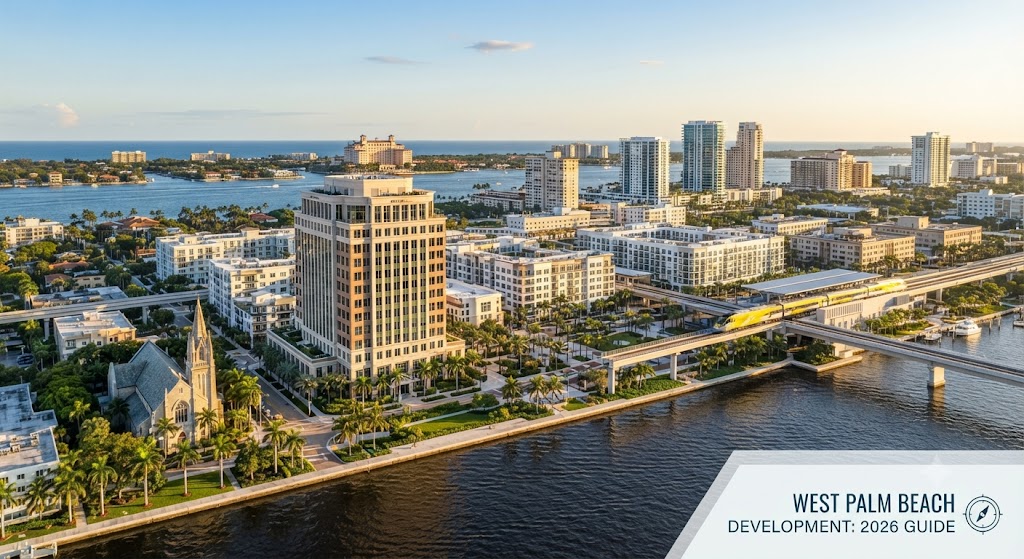
The Definitive Guide to Commercial Real Estate Development in West Palm Beach, Florida (2026): The Top 5 Projects of the Last Five Years — and the Future Projects That Will Change the City
Quick Answer: West Palm Beach is in the middle of the most consequential commercial real estate boom of any mid-sized American city, anchored by developer Stephen Ross’s Related Ross and its nearly $10 billion investment program. The five most transformative projects of the last five years are 360 Rosemary (the 2021 office tower that launched “Wall Street South”), One Flagler (the waterfront trophy tower anchored by estiatorio Milos), the CityPlace transformation (a 72-acre, LEED Gold reinvention of the city’s core), the Nora District (the warehouse-to-lifestyle district north of downtown), and The Press Building (the adaptive reuse of the former Palm Beach Post headquarters). Looking ahead, five projects will define the next era: 10 & 15 CityPlace (roughly 1 million square feet of Class AA offices anchored by ServiceNow’s 850-job AI innovation hub), Vanderbilt University’s $500+ million graduate campus (committed January 2026), the $120 million Phillips Point modernization, the Safe Harbor Rybovich superyacht district, and a multi-billion-dollar luxury residential wave — South Flagler House, the Ritz-Carlton Residences, Shorecrest, and the Northwood Marina Quarter — that supplies the executives every office tower needs.
West Palm Beach Development at a Glance (2026)
| Metric | Figure |
|---|---|
| Related Ross total investment program | ~$10 billion |
| Class A office completed/underway (Related Ross) | ~2.8 million sq. ft. (+1.5M sq. ft. pipeline) |
| Class A office built downtown, 2008–2020 | Effectively zero |
| Downtown residents, ~2015 vs. today | ~6,000 then; multiples of that now and climbing |
| 10 & 15 CityPlace combined | ~1 million sq. ft.; $772M construction financing |
| ServiceNow innovation hub (10 CityPlace) | 850+ jobs; $1.8B projected impact by 2030 |
| Vanderbilt WPB campus | $500M+ project; $300M raised; $250M campaign launched Jan. 2026 |
| Marquee condo benchmark | South Flagler House sales reported above $70 million per unit |
How Did West Palm Beach Become America’s Hottest Mid-Size Development Market?
To understand 2026, start with a statistic the Business Development Board of Palm Beach County likes to cite: between 2008 and 2020, not a single square foot of Class A office space was built in or around West Palm Beach’s central business district. A decade ago, only about 6,000 people lived downtown. The city was a county seat with good weather, a convention center, and a modest financial district — pleasant, but structurally sleepy.
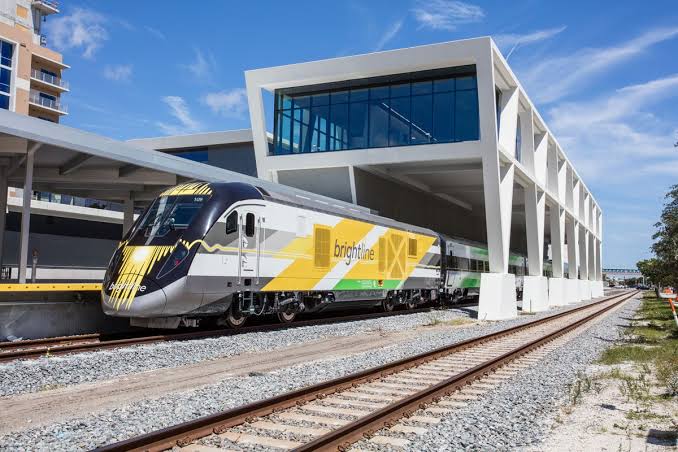
Three forces changed everything at once. First, the wealth migration: Florida’s zero state income tax, accelerated by the pandemic, pulled financial firms and their principals south — Goldman Sachs, BlackRock, Citadel, Point72, Elliott Management, and hundreds of others — creating the “Wall Street South” phenomenon. Second, Brightline: the privately operated rail line put downtown West Palm Beach one comfortable hour from Miami, dissolving the geographic isolation that had capped the city’s ambitions. Third, and most decisively, Stephen Ross went all in. The billionaire developer behind New York’s Hudson Yards — a part-time Palm Beach resident — reorganized his empire around the city, ultimately spinning his Florida operations into Related Ross in 2024 with a stated mission of building West Palm Beach into a national business hub. Banks believed him: lenders have committed well over a billion dollars in construction financing to his West Palm projects in the past two years alone.
The result is a development cycle unlike anything in the city’s history. Here are the five projects that defined its first act — and the pipeline that will define its second.
PART ONE: The Top 5 Commercial Projects of the Last Five Years
1. 360 Rosemary — The Tower That Started It All (Delivered 2021)
Every boom has a proof-of-concept, and West Palm Beach’s is 360 Rosemary: a 300,000-square-foot Class A office tower adjacent to the Brightline corridor and the CityPlace district. When Related delivered it in 2021, it was the first new Class A office building downtown in more than a decade — a speculative bet that Wall Street’s migration would need somewhere to sit.
The bet paid off almost instantly. Goldman Sachs took space, and the leasing sheet that followed read like a Manhattan directory, validating rents that would have been unthinkable in pre-pandemic West Palm Beach. More important than any single lease was what 360 Rosemary proved to the capital markets: institutional-quality tenants would sign institutional-quality leases in this city if someone built institutional-quality product. Every crane on the skyline today traces its financing, directly or indirectly, to that proof.
Why it matters: 360 Rosemary converted “Wall Street South” from a tax-migration story into a real estate asset class. It established the playbook — amenity-rich “lifestyle office” near Brightline and CityPlace — that every subsequent project has followed.
2. One Flagler — The Waterfront Trophy (Delivered 2023–24)
If 360 Rosemary proved the market, One Flagler defined its ceiling. Rising on the Intracoastal waterfront beside the historic First Church of Christ, Scientist, the elegant tower designed by David Childs of SOM brought a genuinely new product to Florida: the boutique waterfront trophy office, with panoramic views across the water to Palm Beach Island and rents to match.
Construction Training Resources
OSHA 30 training fort Lauderdale
electrician apprenticeship South Florida
HVAC apprenticeship fort Lauderdale
plumbing apprenticeship Broward County
Related unveiled the tower to the market with sunset hard-hat tours from neighboring Phillips Point, and anchored its ground plane with a statement: estiatorio Milos, the famed Greek seafood restaurant by Costas Spiliadis, set in a lush waterfront garden — instantly the most important power-lunch room in the city (and, as covered elsewhere in this series, the place where Palm Beach County deals now get closed). Wealth managers, private equity firms, and family offices — tenants who sell proximity to money — pay One Flagler rents precisely because the address itself is the marketing.
Why it matters: One Flagler established West Palm Beach’s Flagler waterfront as a genuine trophy-office district — a category that previously existed in Florida only in Miami’s Brickell — and demonstrated that the city could command top-of-market national rents.
📌 Brian’s Take — The Office Story
Here’s the pattern to internalize from projects one and two: this boom was demand-led, not supply-led. Developers didn’t build towers and pray; the tenants arrived first (2020–21), the buildings followed, and pre-leasing has stayed strong ever since. That sequencing is why West Palm Beach’s office market is thriving while office markets nationally are in crisis — this is the rare American downtown where the office story is about scarcity, not vacancy. When you evaluate any new WPB project, ask the 360 Rosemary question: is a creditworthy tenant base already visible? So far, the answer keeps being yes.
3. The CityPlace Transformation — Reinventing 72 Acres (2021–ongoing)
The most ambitious project of the past five years isn’t a single building; it’s the wholesale reinvention of CityPlace, the 72-acre mixed-use district (known for a period as Rosemary Square) that Related has owned since the 2000s. Over the past five years the company has systematically repositioned it from a suburban-style shopping center into the mixed-use heart of a real city: new dining anchored by concepts like Eataly (the famed Italian marketplace opening its Florida flagship), Michelin-recognized restaurants nearby, the Related Ross Experience Center, cultural programming, and public spaces that host everything from concerts to the announcement of Vanderbilt’s campus.
The district added residential scale with The Laurel, a luxury rental tower with 38,000 square feet of resort-style amenities, and achieved a distinction no Florida neighborhood had before: LEED Gold certification as a neighborhood development — the first in Palm Beach County — recognizing its walkability, transit access, and green infrastructure. CityPlace Tower, the district’s existing Class A office building, won BOMA’s Outstanding Building of the Year for the U.S. Southern Region in 2024. Even mobility is being reinvented: downtown launched an autonomous electric shuttle pilot (the MiCa, in partnership with Related Ross and others) on a route through the district.
Why it matters: CityPlace is the connective tissue of the entire boom — the amenity base that makes the office towers leasable, the residential towers livable, and the future university campus plausible. Its transformation converted West Palm Beach’s biggest liability (a dated mall) into its biggest platform.
4. The Nora District — The Cool Neighborhood the City Was Missing (Opened 2024–25)
Every serious city needs a district that wasn’t master-planned by a billionaire, and West Palm Beach got one in Nora — shorthand for North of Railroad Avenue — a roughly ten-block stretch of century-old warehouses along the FEC tracks just north of downtown, redeveloped by NDT Development and partners into a walkable quarter of restaurants, boutique retail, wellness concepts, and creative office space. Phase one opened through 2024–25 to immediate acclaim, with a hospitality-led tenant mix and an industrial-chic streetscape that gives West Palm Beach its answer to Miami’s Wynwood or Delray’s Pineapple Grove — hip in a way the city’s polished new towers deliberately are not.
Nora’s commercial significance goes beyond its restaurants. It diversified the downtown offer for the young professionals the new employers must recruit; it proved adaptive reuse could pencil in a market obsessed with new construction; and it extended the walkable footprint of downtown northward, pulling investment along the Dixie and Railroad corridors. Future phases contemplate a boutique hotel and additional mixed-use development.
Why it matters: Talent follows lifestyle. Nora is the recruiting brochure — the district that convinces a 28-year-old analyst that West Palm Beach is a real city, not a retirement suburb with office towers.
5. The Press Building — Adaptive Reuse as Economic Development (Delivered 2023–24)
The fifth defining project tells the boom’s story in miniature. The Press Building, at 2751 S. Dixie Highway, is the redevelopment of the former Palm Beach Post headquarters — the printing plant and offices of the region’s declining newspaper — into a 140,000-square-foot Class A mixed-use campus with creative offices and retail. The symbolism writes itself: the infrastructure of the old economy converted, literally, into space for the new one.
The building’s marquee tenant proves the point: in 2025, homegrown fintech MyBambu took the entire fourth floor — 35,000 square feet, one of the largest office leases in the city — for its global headquarters, with plans to grow to roughly 350 employees. A building that once printed the news now houses a neobank moving money to 18 countries. Southward along the Dixie corridor, The Press has helped catalyze a string of restaurant and retail investment connecting downtown to the SoSo (South of Southern) neighborhood.
Why it matters: The Press Building demonstrated that West Palm Beach’s boom has depth beyond the Related Ross portfolio — that independent developers, adaptive reuse, and growth-stage tenants (not just Wall Street relocations) are part of the ecosystem.
📌 Brian’s Take — The Last Five Years, Scored
Rank the five by lasting impact and I’d order them: CityPlace first (it’s the platform everything else plugs into), 360 Rosemary second (proof of concept), One Flagler third (price ceiling), Nora fourth (talent magnet), Press Building fifth (ecosystem depth). Notice what’s not on the list: a single speculative flop. Five years into a historic building cycle, West Palm Beach hasn’t produced its cautionary tale yet — which either means the demand is as real as it looks, or the test simply hasn’t arrived. My money is on the former, but Part Two is where the thesis gets stress-tested, because the next wave is bigger than everything built so far combined.
PART TWO: The Future Projects That Will Change West Palm Beach
1. 10 & 15 CityPlace — One Million Square Feet and an AI Anchor (Under Construction; Delivering ~2027–28)
The largest commercial undertaking in the city’s history broke ground in 2025: 10 CityPlace and 15 CityPlace, twin Class AA office towers rising within the CityPlace district, spanning a combined ~1 million square feet and backed by a $772 million construction financing package — among the largest office construction loans in America in a cycle when most cities can’t finance office at all. 15 CityPlace, designed by Arquitectonica, totals 500,000 square feet across 26 floors with 20,000 square feet of ground-floor retail; 10 CityPlace, by Kohn Pedersen Fox, fronts the district’s central square with civic-scaled architecture.
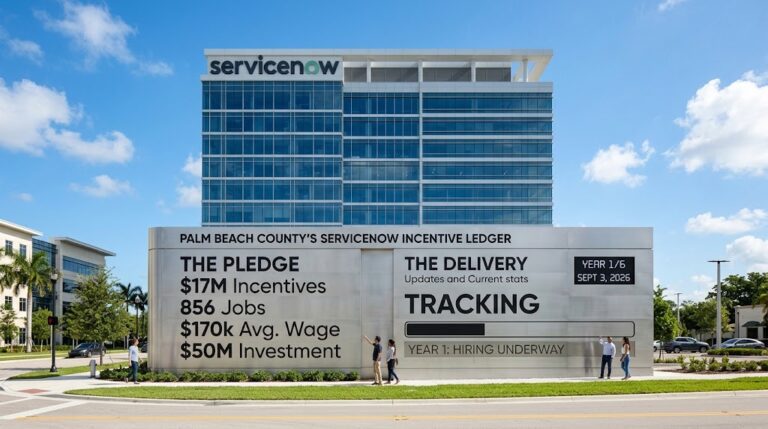
The anchor tenant announcement transformed the project from big to historic: ServiceNow, the Fortune 500 enterprise-software giant, will occupy up to 200,000 square feet at 10 CityPlace for a regional innovation hub housing an AI Institute, accelerator space, and corporate innovation programs — 850+ jobs and a projected $1.8 billion in economic impact by 2030. CEO Bill McDermott declared “the AI innovation economy has a new epicenter in the Gold Coast of West Palm Beach,” and with financial tenants like Wells Fargo and JPMorgan Chase already in the Ross portfolio, the towers position the city to add a technology leg to its finance-dominated economy.
What it changes: These towers roughly double the amount of top-tier office space delivered this cycle and diversify the tenant base from pure finance into enterprise tech and AI — the difference between a hot market and a durable one.
2. Vanderbilt University’s Graduate Campus — The Game-Changer (Committed January 2026)
If one future project rewires the city’s destiny, it’s this. On January 12, 2026, Vanderbilt University Chancellor Daniel Diermeier stood at CityPlace and declared the university “all in on West Palm Beach,” formally committing to build its $500+ million graduate campus downtown after the first fundraising phase — spearheaded by a $50 million gift from Stephen Ross — raised roughly $300 million. A second, $250 million campaign launched the same day. The Board of Trust has authorized work to begin.
The campus will rise on seven acres between Fern and Evernia/Datura streets east of Tamarind Avenue, land donated unanimously by the city and county, near the Tri-Rail station and Dreyfoos School of the Arts — walking distance from both the Brightline station and CityPlace. Designed by Elkus Manfredi Architects (whose late co-founder Howard Elkus designed the original CityPlace) as a “living laboratory of South Florida landscape,” it is planned for roughly 1,000 graduate students and 100 faculty, with programs targeting finance, management, engineering, AI and data science, space technology, defense technology, and business innovation — plus executive education and workforce programs built with local employers, and a public-facing innovation hub for entrepreneurial activity. (Academic programming remains subject to approval by Florida’s education regulators.)
What it changes: Everything downstream of talent. A top-15 national research university with a 12% graduate admissions rate, planted between the train stations and the office towers, gives every employer in the city a recruiting pipeline, gives the fintech and AI ecosystem a research partner, and gives West Palm Beach the one asset money couldn’t previously buy: academic gravity. This is how boomtowns become permanent cities.
📌 Brian’s Take — Vanderbilt Is the Whole Ballgame
I’ll say it plainly: the Vanderbilt commitment is the most important economic development event in Palm Beach County’s modern history — bigger than any tower, bigger than ServiceNow. Office buildings house an economy; universities reproduce one. A thousand elite graduate students a year in AI, finance, and engineering, interning at firms two blocks away, is a perpetual-motion talent machine — and it de-risks every other project on this list. Note also the machinery behind it: Ross donated $50M, hosts the announcements at his Experience Center, and builds the towers those graduates will work in. Agree or disagree with one man holding that much influence over a city, the flywheel is undeniably engineered — land, offices, housing, amenities, transit, and now the university, all interlocking.
3. The Phillips Point Modernization — Protecting the Crown Jewel ($120M; Completing Late 2026)
Not all transformative development is new construction. Phillips Point, the landmark 449,000-square-foot waterfront office complex with 270-degree views of the Atlantic, the Intracoastal, and Palm Beach Island, is undergoing a $120 million modernization — reimagined by Roger Ferris + Partners with interiors by Ingrao Inc. — that will convert the 1980s icon into a Class A+ destination with upgraded energy-efficient infrastructure, a modern limestone façade, and new street-level retail and dining along Flagler Drive, with completion expected by the end of 2026.
What it changes: It signals the market’s maturation from building new supply to defending existing trophy assets — and extends the activated Flagler waterfront retail experience between One Flagler and the Royal Park Bridge, knitting the financial district to the street.
4. The Safe Harbor Rybovich District — The Marine-Economy Megaproject
Covered in depth in this series’ boating-industry installment, the redevelopment of the historic Rybovich yacht yard deserves its place on any list of city-changing projects. Safe Harbor Marinas’ $369 million acquisition set two transformations in motion: a consolidated 23-acre superyacht service campus in Riviera Beach billed as the largest superyacht repair facility in the United States (projected to inject $300+ million annually into the local economy), and the redevelopment of the original North Flagler Drive waterfront yard, where development trackers now list a Safe Harbor Rybovich District proposal reaching 36 stories and roughly 660 residential units — which would rank among the tallest and densest projects in the city’s pipeline, extending the luxury waterfront corridor north from downtown.
What it changes: It converts a century-old industrial waterfront into a dual engine — high-wage marine industry to the north, high-value mixed-use development on North Flagler — and pulls the boom’s geography beyond the downtown core.
5. The Residential Wave — Housing the Boom (2026–2028)
Commercial real estate ultimately fails without rooftops, and the residential pipeline now under way is staggering in both scale and price point. The benchmark is South Flagler House, Related Ross’s $600 million, RAMSA-designed condominium on the Intracoastal — topped off, backed by a $600 million debt package, and recording sales above $70 million per unit, numbers previously reserved for Manhattan and Palm Beach Island itself. The Ritz-Carlton Residences, with an Olympic-size pool, spa, and private residential marina, breaks ground in early 2026 for 2027 completion. Shorecrest, a 28-story, 98-unit waterfront tower at 1865 North Flagler (on the former Temple Israel site), secured a $157 million construction loan in February 2026 with Equinox-managed amenities and 2027 delivery. The two-tower, 168-unit Edgeworth launched sales in March 2026; and in May 2026 Related Ross paid $55 million for a full downtown block between Dixie Highway and Quadrille for yet another condo tower of 100–130 units.
Beyond Related’s portfolio, the Northwood Marina Quarter (NOMAR) — a multi-billion-dollar, multi-phase revitalization led by Huizenga Holdings with GL Homes — aims to connect the city’s north-end neighborhoods to the Intracoastal, while towers like the 22-story Alba Palm Beach bring private-dock living to Northwood. The Nora district’s momentum and mixed-use launches at sites like 400 Hibiscus Street round out a residential map that finally matches the commercial one.
What it changes: The housing wave completes the live-work-play loop — executives at One Flagler, ServiceNow engineers at 10 CityPlace, and Vanderbilt faculty all need addresses — and its ultra-luxury pricing continuously re-rates land values across the city, funding the next round of development.
📌 Brian’s Take — Reading the Pipeline
The future pipeline has a shape worth naming: offices for the jobs, a university for the talent, condos for the wealth, and a superyacht district for the lifestyle — four legs, one stool. The honest risks: Brightline’s finances (its corporate distress is real, though the corridor’s value all but guarantees the trains keep running under someone’s ownership); affordability (a city of $70 million condos must still house its teachers, nurses, and service workers, and the political pressure on that front is building); and concentration (an extraordinary share of this pipeline runs through one firm’s balance sheet). But weigh those against a market where the anchor tenants — Goldman, ServiceNow, Vanderbilt — are already signed, and the risk-adjusted picture remains the strongest of any mid-size downtown in America.
What Could Slow the Boom?
A definitive account owes readers the bear case. Interest rates and construction costs remain elevated, and while Related Ross keeps closing nine-figure loans, smaller developers face a harder market. Insurance costs — the tax of Florida coastal real estate — pressure every pro forma. Infrastructure strain is visible: traffic on Okeechobee Boulevard, workforce-housing scarcity, and school capacity all lag the growth, and Brightline’s corporate turbulence adds uncertainty to the transit story even as its WPB corridor thrives. Finally, there’s key-person concentration: the ecosystem’s architect, Stephen Ross, is in his eighties, and while Related Ross is institutionalized, no honest analysis ignores how much of the flywheel one person set spinning. None of these threats looks fatal in 2026 — pre-leasing, fundraising, and sales velocity all argue otherwise — but they are the variables to watch.
Frequently Asked Questions
What is the biggest development project in West Palm Beach right now? By square footage and financing, the combined 10 & 15 CityPlace office towers (~1 million square feet, $772 million construction package) lead the pipeline; by long-term impact, Vanderbilt University’s $500+ million graduate campus, committed in January 2026, is arguably bigger.
Who is the largest developer in West Palm Beach? Related Ross, the West Palm Beach-headquartered firm of Stephen Ross, with a stated ~$10 billion investment program spanning offices (One Flagler, 360 Rosemary, 10 & 15 CityPlace, Phillips Point), residential (South Flagler House, The Laurel, Shorecrest, Edgeworth), and the 72-acre CityPlace district.
Why are companies moving offices to West Palm Beach? No state income tax, the Wall Street South financial cluster, Brightline rail access to Miami, new Class AA office supply unavailable in most cities, and — increasingly — the talent pipeline promised by Vanderbilt’s campus and ServiceNow’s AI Institute.
When will Vanderbilt’s West Palm Beach campus open? Vanderbilt committed to proceed in January 2026 after raising ~$300 million, launched a further $250 million campaign, and is finalizing designs and regulatory approvals; construction and programming timelines will be announced as approvals conclude, with early programming targeted as soon as feasible.
Is the West Palm Beach real estate boom sustainable? The demand indicators — pre-leased towers, record condo pricing, signed anchor tenants — argue yes; the risks are affordability, insurance and construction costs, infrastructure strain, Brightline’s corporate finances, and concentration in a single developer’s pipeline.
References and Sources
- Related Ross — corporate site, office portfolio, press releases (One Flagler, 360 Rosemary, 10 & 15 CityPlace, Phillips Point modernization, CityPlace LEED Gold, The Laurel, ~$10B program). https://www.relatedross.com
- Forbes (Brad Hunter) — “What Is Driving the Explosion of Development in West Palm Beach?” (April 2026): South Flagler House, Ritz-Carlton Residences, NOMAR/Northwood, $772M loan package. https://www.forbes.com
- Commercial Observer — Related Ross financings and acquisitions: Shorecrest $157M loan (Feb. 2026), $55M downtown block purchase (May 2026), $600M South Flagler debt package. https://commercialobserver.com
- NAIOP Development Magazine — 10 & 15 CityPlace groundbreaking specifications (Summer 2025). https://www.naiop.org
- Vanderbilt University & WLRN / CBS12 — West Palm Beach campus commitment, $300M raised, $250M campaign, site, Elkus Manfredi, 1,000 students/100 faculty (Jan.–Feb. 2026). https://www.vanderbilt.edu; https://www.wlrn.org
- Venture Tech Chronicle — ServiceNow innovation hub at 10 CityPlace (850+ jobs, $1.8B impact). https://www.vtchronicle.com
- Markets of Tomorrow — West Palm Beach office pipeline tracker (Safe Harbor Rybovich District, 36 floors/660 units; Arquitectonica market share). https://www.oftmw.com
- Stet News — Safe Harbor/Rybovich Riviera Beach expansion and West Palm yard redevelopment. https://stetnews.org
- Dan’s Papers / BDB — downtown Class A construction history, Nora district, Vanderbilt economic projections. https://www.danspapers.com; https://bdb.org
Project specifications, financing figures, and timelines reflect public reporting as of July 2026 and are subject to change; verify current status with developers, lenders, and municipal filings before making business or investment decisions.
About the Author