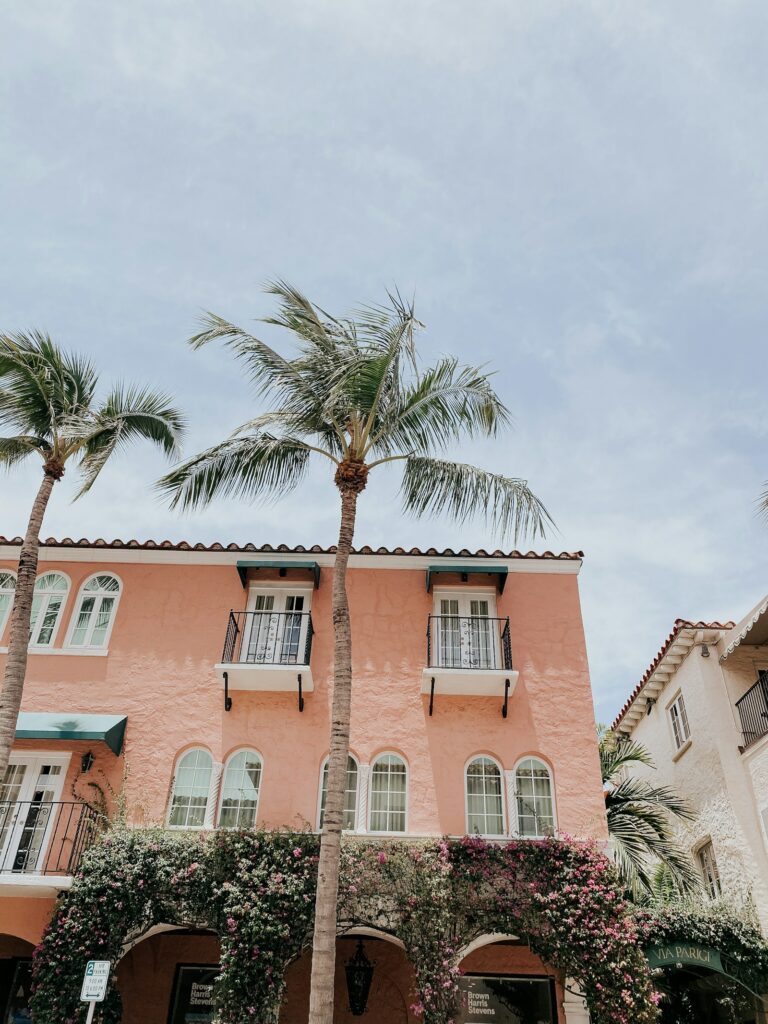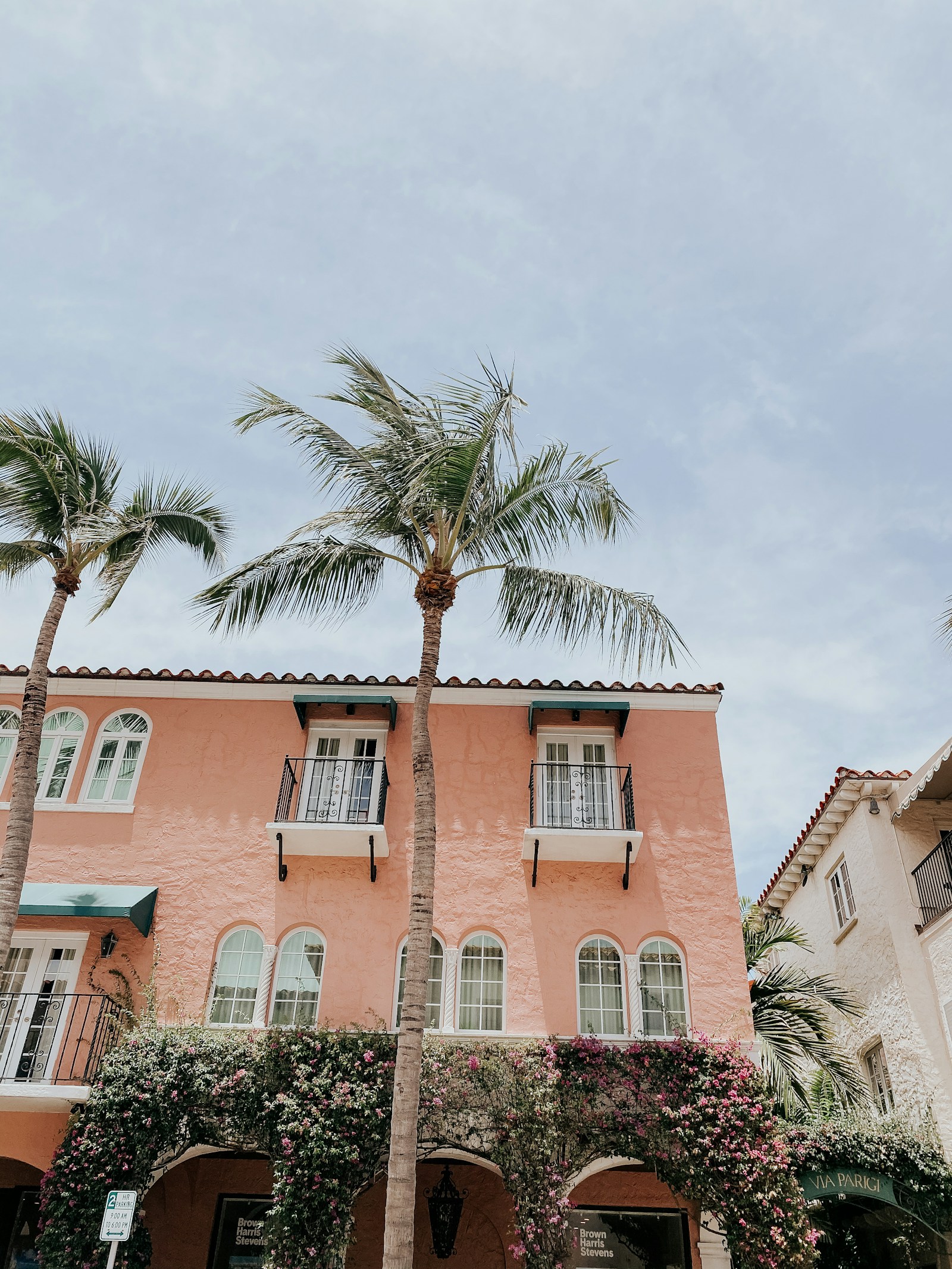
A palm-lined building in Palm Beach, Florida. Source: Tessa Edmiston, Unsplash, Unsplash License.
Quick Answer: Palm Beach County’s 2026 taxable value reached about $367.4 billion, up 7.35% from 2025, including $5.47 billion of net new value, according to the Property Appraiser’s preliminary roll. County commissioners kept the countywide operating millage at 4.5000 in September, which is 5.44% above the rollback rate, inside a $9.96 billion all-funds FY2027 budget. That means many commercial property owners will pay higher county taxes even though the rate did not change.
Palm Beach County’s property tax base grew again in 2026, and the county budget that took effect October 1 is built on that growth. The Palm Beach County Property Appraiser’s 2026 preliminary tax roll puts countywide taxable value at $367,368,160,674. The 2025 final roll was $342,225,146,643, so the increase is 7.35%. The Board of County Commissioners then adopted a FY2027 budget that left the countywide operating rate at 4.5000 mills. WLRN reported on September 17, 2026, that the countywide portion of the budget totals $8.26 billion.
For businesses, the key point is how the rate and the values interact. The county did not raise its millage, but it also did not lower it to the rollback rate, which is the rate that would collect the same revenue as last year from existing property. Owners of offices, retail centers, warehouses and other non-homestead property are not covered by homestead protections. Many of them will pay more in county taxes this year because their assessed values rose.
How much is Palm Beach County’s 2026 tax roll worth?
The Property Appraiser’s office, led by Property Appraiser Dorothy Jacks, reported these countywide totals for the January 1, 2026 valuation date:
| Measure (2026 tax roll) | Value |
|---|---|
| Total taxable value (preliminary) | $367,368,160,674 |
| 2025 final taxable value | $342,225,146,643 |
| Growth including net new value | 7.35% |
| Growth from existing property only | 5.75% (to $361,901,291,747) |
| Net new value (new construction, additions, annexations, deletions) | $5,466,868,927 |
| Total market value | $551,940,574,726 |
| Parcels | 662,126 |
| Tangible personal property accounts | 57,383 |
Market value is about $552 billion, while taxable value is about $367 billion. The difference of roughly $185 billion comes from exemptions and assessment caps. Commercial and other non-homestead parcels do not get homestead exemptions, so their taxable values generally track market value more closely than homesteaded homes do.
How much of the growth came from new construction?
Net new value was $5.47 billion. That category covers new construction, additions and annexations, minus deletions. Excluding it, the existing tax base grew 5.75%. Counting it, the base grew 7.35%. Roughly 1.6 percentage points of this year’s growth therefore came from property that was added to the roll, not from existing properties going up in value.
What happens next on the tax calendar?
The Property Appraiser’s office said Notices of Proposed Property Taxes (TRIM notices) would be mailed August 20 and tax bills would follow on November 1, after the roll was certified. In its tax roll release, Jacks wrote: “No matter the outcome of the 2026 property tax ballot initiative, my office continues our constitutional duty.”
Which Palm Beach County cities grew the most in taxable value?
The preliminary roll shows growth in every major municipality, but the rate varied a lot. The table below includes net new value in the 2026 figures.
| Municipality | 2025 final | 2026 preliminary | Change | Net new value |
|---|---|---|---|---|
| Boca Raton | $40.06B | $42.71B | 6.63% | $586.9M |
| Palm Beach | $34.61B | $37.73B | 8.99% | $215.2M |
| West Palm Beach | $25.39B | $27.85B | 9.68% | $758.3M |
| Palm Beach Gardens | $21.70B | $23.57B | 8.58% | $616.8M |
| Delray Beach | $19.59B | $21.06B | 7.48% | $316.5M |
| Jupiter | $18.45B | $19.63B | 6.40% | $134.9M |
| Wellington | $13.22B | $13.93B | 5.33% | $81.0M |
| Boynton Beach | $10.50B | $11.06B | 5.29% | $83.9M |
| Westlake | $1.61B | $1.99B | 23.73% | $263.7M |
Why did West Palm Beach lead the large cities?
West Palm Beach’s taxable value grew 9.68%, to about $27.85 billion, the fastest rate among the large cities on the list. The city also had the most net new value of any municipality in the table, at $758.3 million. That is more than Boca Raton’s $586.9 million, even though Boca Raton’s overall tax base is about $15 billion larger. A large share of the city’s growth came from newly added property, not only from revaluation of existing parcels.
How do Boca Raton, Palm Beach and Palm Beach Gardens compare?
Boca Raton is still the county’s largest municipal tax base at $42.71 billion, but it grew a more modest 6.63%. The Town of Palm Beach added 8.99% to reach $37.73 billion, and only $215.2 million of that came from net new value. Nearly all of the town’s gain therefore came from existing properties being reassessed higher. Palm Beach Gardens grew 8.58% to $23.57 billion, with $616.8 million in net new value, the second-highest amount in the table. Jupiter (6.40%), Wellington (5.33%) and Boynton Beach (5.29%) were below the countywide average.
What is happening in Westlake?
Westlake’s 23.73% increase looks dramatic, but its base is small. Net new value of $263.7 million accounts for most of the roughly $381 million gain. Most of Westlake’s growth comes from new property being added to the roll.
What did Palm Beach County adopt for its FY2027 budget and millage?
The county held its first budget hearing on September 3 and its second on September 15, 2026. The package for the second hearing set out these FY2027 rates and budgets, and WLRN reported that commissioners approved the budget with the countywide rate held at $4.50 per $1,000 of value.
| Levy | FY2027 millage | Rollback rate | Tax revenue |
|---|---|---|---|
| Countywide operating (General Fund) | 4.5000 | 4.2678 (5.44% over) | $1,653,156,723 |
| Countywide voted debt | 0.0210 (was 0.0330) | n/a | $7,718,798 |
| County Library District | 0.5491 | 0.5213 (5.33% over) | $106,069,210 |
| Fire Rescue MSTU | 3.4581 | 3.2856 (5.25% over) | $514,368,300 |
| Jupiter Fire-Rescue MSTU | 0.0000 (was 1.7251) | n/a | Eliminated |
| Aggregate | 6.1889 | 5.9577 (3.88% over) | $2,281,313,031 |
Under Florida’s truth-in-millage rules, a rate above rollback is legally a tax increase, even when the rate itself is unchanged. The county’s July 7 budget presentation estimated that the General Fund operating levy would bring in $109.9 million more than the year before, a 7.1% increase. Property taxes across all levies were projected to rise $114.1 million, or 5.3%. WLRN summarized the outcome as roughly 3.9% more property tax revenue than last year, which is close to the 3.88% by which the aggregate rate exceeds rollback.
How big is the FY2027 budget?
The total budget across all funds is $9,959,875,419, up 3.7% from $9.61 billion in FY2026, according to the FY2027 Budget Fact Sheet. Countywide funds account for $8.26 billion gross, or $7.26 billion net of internal transfers. The General Fund is about $2.60 billion. The Fire Rescue MSTU budget is $1.22 billion, the County Library District $326.2 million and the Municipal Service Taxing District $133.8 million. The budget funds 12,920 positions. Of those, 7,454 are under the Board of County Commissioners and 4,646 are with the Sheriff’s Office.
Where is the money going?
| Spending category (all funds) | FY2027 | Change vs. FY2026 |
|---|---|---|
| Public safety | $2,298.0M | +8.8% |
| Reserves | $2,046.4M | +1.2% |
| Transportation | $1,283.4M | +3.4% |
| General government | $1,078.5M | -8.9% |
| Physical environment | $913.4M | +26.6% |
| Culture and recreation | $583.3M | +4.3% |
| Economic environment | $382.3M | +13.1% |
| Human services | $158.0M | -7.8% |
The fact sheet attributes the 26.6% increase in physical environment spending to a C-51 Reservoir Phase II pump station grant and to Water Utilities infrastructure capital funded by enterprise revenues. It attributes the 13.1% increase in economic environment spending to affordable housing projects and Community Redevelopment Agencies. In the General Fund, the July presentation showed payments to CRAs rising 10.2% to $92.5 million. That increase is a direct result of rising property values inside redevelopment districts, and the faster growth in values inside those districts flows to them.
Ad valorem-funded capital totals $217.2 million. Of that, $53.8 million goes to Fire Rescue, $48.1 million to roadway improvements, $39.4 million to the County Library, $30 million to Parks and Recreation, $25.3 million to the Office of Technology and Innovation and $13.8 million to repair and renovation of county buildings.
What happened with the Sheriff’s budget?
The Sheriff’s Office is the largest single line in the budget, with a gross FY2027 budget of $1,178,269,394. The July 7 presentation showed that the Sheriff originally requested $1,071,239,900, a 9.53% increase over the FY2026 adopted figure of $977,996,076. Commissioners cut $20 million in July. The second-hearing package added a further $8 million reduction, along with a $16.8 million carryforward for equipment and other items that were not received in FY2026. WLRN described the total as a record $32 million cut to the Sheriff’s Office and said it helped secure approval of the budget.
Did the county consider a lower rate?
Yes. At the July 7 workshop, staff estimated that cutting the operating rate to 4.4000 would require $34.9 million in spending reductions. Going all the way to rollback would require another $86 million in cuts. The presentation also described SB 4F, signed June 24, 2026, and effective July 1. Under that law, a majority vote can set a rate no higher than rollback, a two-thirds vote can go up to 110% of rollback, and anything higher requires a unanimous vote. The board set its not-to-exceed rate at 4.5000, and that rate was ultimately adopted.
What does this mean for businesses and commercial property owners?
Here is a simple example. A commercial property with $1 million of taxable value pays $4,500 to the county’s countywide operating levy at 4.5000 mills. Library, fire rescue, municipal, school and special district levies, where they apply, are added on top. If that property’s assessment rose 7%, the county operating portion goes up about $315 even though the rate stayed the same. Under the current 10% annual cap on non-homestead assessed values, increases can be larger when market values have run ahead of assessments.
Homeowners are in a different position. The July presentation estimated that the county-portion tax on a median homestead would rise just $21.95, or 2.8%, to $808.78. The median homestead taxable value rose 3.1%. This gap between homestead and non-homestead property is where business owners feel the difference most.
How does Amendment 3 change the outlook?
Florida voters approved Amendment 3 in November with about 62% of the vote, above the 60% threshold, CBS12 reported. Starting January 1, 2027, the amendment raises the homestead exemption for non-school taxes to $150,000 in 2027 and $250,000 in 2028. It also lowers the annual assessment cap on non-homestead property, including commercial property, rentals and second homes, from 10% to 5% for non-school levies. It does not affect 2026 tax bills.
For commercial owners, the tighter cap limits how fast assessed values can climb starting in 2027. However, Palm Beach County estimates its General Fund could lose about $233 million a year once the amendment is fully in place, according to CBS12. That is about 14% of this year’s $1.65 billion countywide operating levy. When the homestead base shrinks, commissioners will have to cut spending, raise rates, add fees or rely more on non-homestead property. The July presentation already listed a fire fee assessment as a next step, and fees of that kind apply to businesses regardless of exemptions.
Brian’s Take
A tax base growing 7.35% in one year shows a county that is still attracting capital. West Palm Beach adding $758 million of new value, more than any city on the list, shows new building turning into recurring revenue. That is good news for the city. But the county kept its rate 5.44% above rollback, so a business owner whose assessment went up is paying more this year. The rate staying flat does not mean the bill stays flat.
The bigger question is what happens in 2027. Amendment 3 gives commercial owners a 5% cap, which helps. It also takes an estimated $233 million a year out of the county’s General Fund, and that money has to come from somewhere. My concern is that the burden moves toward fees and toward property without homestead protection, which is mostly business property. Commercial owners and their tax advisers should watch next summer’s budget workshops closely, not just the August TRIM notices.
Frequently Asked Questions
What is Palm Beach County’s 2026 taxable value?
The Property Appraiser’s 2026 preliminary roll lists countywide taxable value of $367,368,160,674, up 7.35% from the 2025 final roll of $342.2 billion.
What is the Palm Beach County millage rate for FY2027?
The countywide operating rate is 4.5000 mills, unchanged from FY2026 and 5.44% above the 4.2678 rollback rate. The aggregate county rate is 6.1889 mills.
How large is Palm Beach County’s FY2027 budget?
The all-funds budget is $9.96 billion, up 3.7%. Countywide funds total $8.26 billion gross, and the General Fund is about $2.60 billion.
Which city had the most new construction value?
Among the municipalities in the Property Appraiser’s preliminary data, West Palm Beach had the most net new value, $758.3 million, followed by Palm Beach Gardens at $616.8 million.
Does Amendment 3 lower taxes on commercial property?
Commercial property does not receive the larger homestead exemption. Starting in 2027, its annual assessment increases for non-school taxes are capped at 5% instead of 10%.
Sources and Further Reading
- 2026 Tax Roll Preliminary (media summary) — Palm Beach County Property Appraiser
- Property Appraiser Provides 2026 Tax Roll Preliminaries to Local Governments — Palm Beach County Property Appraiser
- FY 2027 Budget Fact Sheet — Palm Beach County Office of Financial Management and Budget
- FY 2027 July 7th Budget Presentation — Palm Beach County Office of Financial Management and Budget
- September 15th Second Public Hearing Package — Palm Beach County Board of County Commissioners
- Palm Beach County approves budget as it grapples with law enforcement spending, rising taxes — WLRN
- Florida homeowners could pay less under Amendment 3. Here’s how it works — CBS12 (WPEC)
About the Author