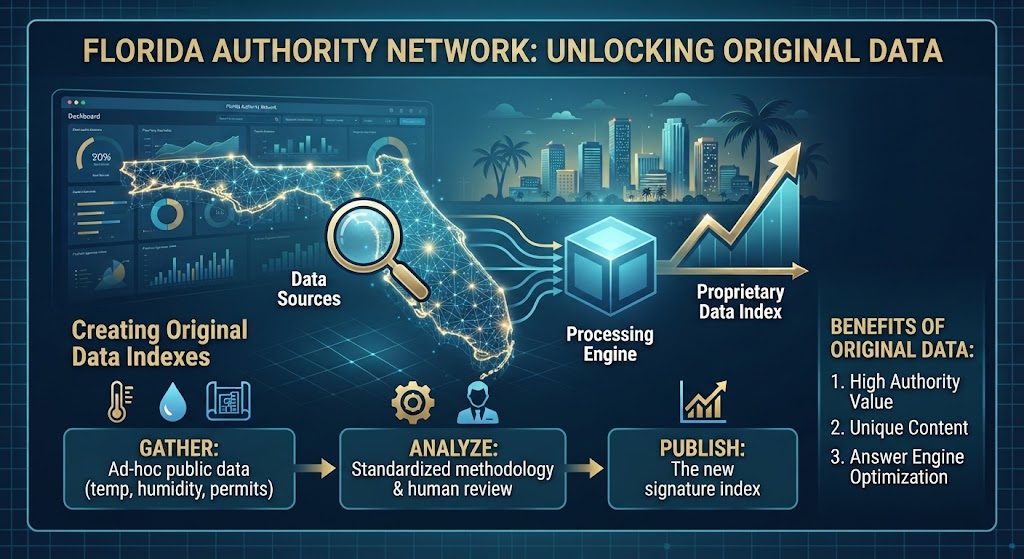
Quick Answer: The Florida Authority Network plans to build original data indexes, one signature index per site, from public data tracked over time. Planned examples include an outdoor worker heat index and building-permit trends. The rollout waits until each news site has 50+ high-quality articles.
From Reporting Data to Creating It
Most news organizations report data that someone else produced. A government agency releases unemployment figures; outlets write them up. A trade group publishes a survey; reporters quote it.
The Florida Authority Network’s next phase goes a step further: creating entirely new proprietary data.
The idea is to take ad hoc public data points, information that exists but is scattered, inconsistent, or never compiled, and track it systematically over time. Turned into indexes, that data becomes something no one else has: original, Florida-specific, and updated on a regular schedule.
Why Original Data Matters
Original data is one of the strongest forms of authority a publisher can build.
When a publication produces a number no one else produces, other people have to cite it. Reporters reference it. Businesses use it in planning. And AI answer engines, which look for credible, specific, verifiable sources, have a reason to point back to the original.
| Content Type | Who Else Has It? | Authority Value |
|---|---|---|
| Rewritten news | Many outlets | Low |
| Original analysis | Few | Medium |
| Proprietary index | Only the creator | High |
For a network built around answer engine optimization, a well-designed index is the logical next step beyond long-form articles.
The Goal: One Great Index Per Site
FAN’s plan is to develop one signature index for each site, matched to that site’s region or industry.
A regional site might track a local economic indicator. An industry site might track a sector-specific trend. Each index gives its home site a recurring, original reason to exist in its niche, and a data series that grows more valuable the longer it runs.
The emphasis is on quality over quantity. One rigorous, well-explained index per site is worth far more than a dozen thin ones.
Example: An Outdoor Worker Heat Index
One index concept shows the approach well: an outdoor worker heat index calculated for specific Florida locations.
Florida’s heat is a serious workplace issue. Construction crews, landscapers, roofers, agricultural workers, utility crews, and delivery drivers work outside through long, humid summers. Yet the most common measure people check, the air temperature, captures only part of the risk.
The planned index is a composite built from five to six daily inputs, guided by OSHA’s heat-safety guidance, rather than temperature alone. Inputs under consideration include factors such as:
| Possible Input | Why It Matters |
|---|---|
| Air temperature | Baseline heat load |
| Humidity | Limits sweat cooling |
| Sun exposure / UV | Adds radiant heat |
| Wind speed | Affects cooling |
| Overnight low | Body recovery time |
| Duration of high heat | Cumulative strain |
Inputs shown are illustrative; the final methodology is still in development.
Combining these into a single daily reading per location would give Florida employers, safety managers, and workers a more complete picture than a thermometer alone.
The topic also has a policy backdrop. In 2024, Florida enacted legislation (HB 433) that prevents local governments from adopting their own heat-exposure protection requirements for workers. With local rules preempted, independent, location-specific information about heat conditions arguably becomes more useful to employers making their own safety decisions.
Example: Building Permit Trends
A second category of index draws on building permits, one of the most useful leading indicators in any local economy.
Permits signal future activity before it happens: new homes, commercial construction, renovations, and infrastructure. Tracked consistently by county or metro area, permit data can show where Florida growth is accelerating, cooling, or shifting.
Some permit data is already compiled nationally, including through the U.S. Census Bureau’s Building Permits Survey. But local permit details often sit in separate county and municipal systems with different formats. Assembling that information consistently, over time, for specific Florida markets is exactly the kind of composite work FAN is built to do.
Why the Indexes Wait: The Seasoning Threshold
FAN is deliberately not launching its indexes yet. In September 2026, Brian French set a clear sequencing rule: each news site should reach 50 or more high-quality articles before index work begins.
He describes this as letting the sites season. A new site with only a handful of articles hasn’t yet established its subject, its audience, or its credibility. An index launched there would have little authority behind it.
A site with 50-plus substantive articles is a different asset. It has shown it covers its niche seriously and consistently. An index added at that point builds on an existing foundation.
FloridaTechnologyNews.com illustrates the timeline. It launched in mid-July 2026 and passed the 50-article mark by early September, an early example of a site reaching seasoning in roughly seven weeks.
Principles Behind a Credible Index
For an index to be trusted, its method has to be as solid as its data. FAN’s analyst-led approach points to a few working principles:
- Transparent methodology. Readers should be able to see what goes in and how it’s weighted.
- Public, verifiable inputs. Data should come from sources others can check.
- Consistency over time. Methods shouldn’t quietly change; when they do, changes should be disclosed.
- Plain-language explanation. Every reading should come with context on what it means.
- Human review. Automated calculation, with an analyst checking the output before it publishes.
These mirror the discipline of investment research, where an indicator is only useful if its construction is understood and stable.
How the Indexes Fit the Bigger Picture
The indexes connect to FAN’s broader structure. The network’s 35 sites cover Florida regions and industries; long-form articles establish authority; business profiles create consistent facts about companies; and a planned master site, FlAuthorityNetwork.com, will serve as the canonical hub.
Indexes add the final layer: original information that exists nowhere else. They give each site a recurring signature, give readers a reason to return, and give answer engines a distinctive source to cite.
Brian’s Take
In my investment days, the most valuable research wasn’t the reports that summarized what everyone already knew. It was the work that found a signal no one else was tracking.
That’s the idea behind these indexes. Florida produces enormous amounts of public data that nobody stitches together consistently. Permits, weather conditions, filings, local records: the raw material is sitting there. The value comes from collecting it the same way, every time, and explaining it honestly.
I’m intentionally being patient about the launch. An index on a site with twelve articles is a gimmick. An index on a site with fifty-plus serious articles is a resource. I’d rather do it right than do it first.
Frequently Asked Questions
What is a proprietary data index?
An original measurement created by combining data points and tracking them over time, producing information not available elsewhere.
What is the outdoor worker heat index?
A planned FAN composite index using five to six daily inputs, guided by OSHA heat-safety guidance, to measure outdoor heat risk by Florida location.
Why not just use the temperature?
Temperature misses humidity, sun exposure, wind, and recovery time, which all affect how dangerous heat is for people working outside.
When will FAN launch its indexes?
After each news site reaches 50 or more high-quality articles, a threshold FAN calls “seasoning.”
Will index methods be published?
FAN’s approach emphasizes transparent, verifiable methodology so readers understand how each index is built.
Can businesses sponsor or contribute to an index?
Businesses interested in FAN’s index work can call 813-409-4683.
Sources and Further Reading
- OSHA, Heat Exposure overview — https://www.osha.gov/heat-exposure
- National Weather Service, Heat Index — https://www.weather.gov/safety/heat-index
- Florida Senate, CS/CS/HB 433 (2024) — https://www.flsenate.gov/Session/Bill/2024/433
- U.S. Census Bureau, Building Permits Survey — https://www.census.gov/construction/bps/
- Florida Authority Network article archive on Authory — https://authory.com/FloridaAuthorityNetwork
About the Author