WestPalmBeachBusinessNews.com | By Brian French | Published September 3, 2026 | Refreshed annually, with interim updates as milestone reports are filed
Promise vs. Delivery: Palm Beach County’s ServiceNow Incentive Ledger
WestPalmBeachBusinessNews.com | By Brian French | Published September 3, 2026 | Refreshed annually, with interim updates as milestone reports are filed
Quick Answer
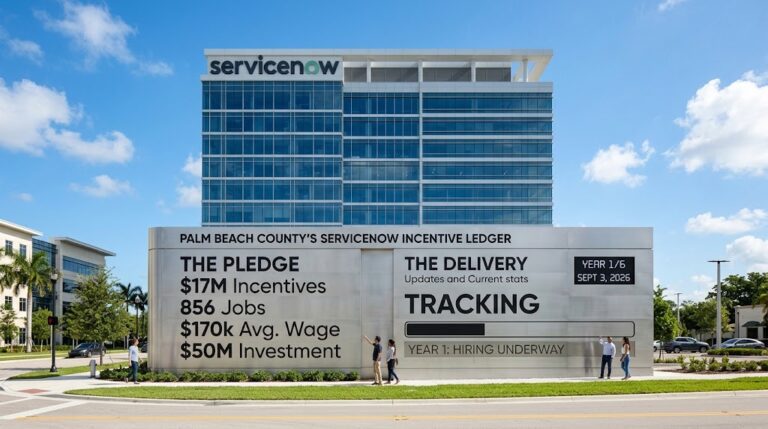
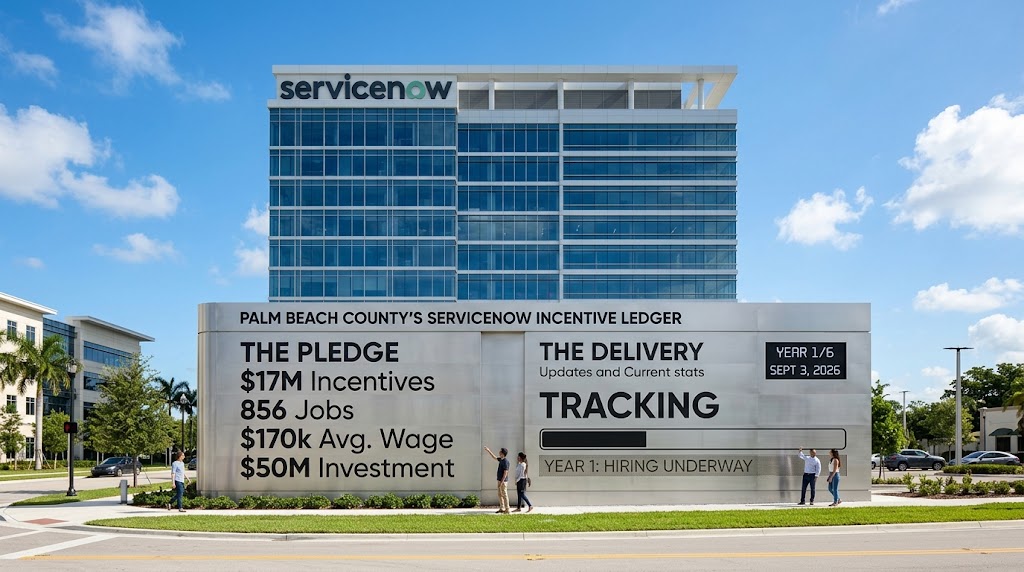
ServiceNow’s West Palm Beach expansion is backed by about $17 million in public incentives: roughly $13 million from FloridaCommerce, about $2 million in other state grants, and $2 million from the City of West Palm Beach paid over six years. In return, the company committed to 856 jobs within six years at an average wage of $170,000, plus a $50 million capital investment.
That works out to about $19,860 per pledged job. The city’s clawback triggers only if ServiceNow creates fewer than 400 jobs, so the company keeps the city’s money even if it delivers less than half its headline pledge.
By FAN’s cost-per-job measure, the deal is roughly 50 times cheaper per direct job than Palm Beach County’s Scripps Florida (about $1.06 million per job) and Max Planck Florida (about $1.34 million per job) recruitments. Those institutions were funded as anchors for a biotech cluster, and the cluster’s 50,000-job vision was never met. FAN’s Incentive Ledger launches with five tracked deals and will score each against its own milestone schedule.
Key Numbers at a Glance
| Metric | Figure | Source |
|---|---|---|
| Total ServiceNow public incentives | ~$17 million | Commercial Observer / WPTV; The Real Deal; WLRN |
| State portion | ~13MFloridaCommerce+ 2M other state grants | The Real Deal (citing Palm Beach Post) |
| City of West Palm Beach portion | $2 million over six years | The Real Deal; Venture Tech Chronicle |
| Job commitment | 856 jobs within six years | WFLX (city records); The Real Deal |
| Clawback trigger (city funds) | Fewer than 400 jobs created | The Real Deal; Venture Tech Chronicle |
| Committed average wage | $170,000 | Refresh Miami (citing city records) |
| Committed capital investment | $50 million | Refresh Miami |
| Projected economic impact | ~$1.8 billion over five years (company-commissioned study) | ServiceNow; Palm Beach Now |
| Local-hire target | ~80% of hires, with Palm Beach State College training | Palm Beach Now |
| Permanent facility opening | Mid-2028 (10 CityPlace); temporary space in the interim | WLRN |
| Scripps Florida incentives (2003–06) | ~310Mstate+ 269M county (land, building, infrastructure) | Public record; WPTV |
| Max Planck Florida incentives (2008) | $94M state Innovation Incentive Fund + 86.9Mcounty( 181–190M) | BioSpace (BDB release); OnGardens |
| Jeb Bush-era biotech vision | 50,000 jobs in 15 years — not met | WPTV, Dec. 2021 |
The FAN Palm Beach County Incentive Ledger
| # | Recipient | Year | Public $ (state + local) | Jobs contracted | Avg. wage committed | Cost per contracted job | Clawback / milestone terms | Delivery status (Sept 2026) |
|---|---|---|---|---|---|---|---|---|
| 1 | ServiceNow | 2025 | ~17M( 15M state, $2M city) | 856 in 6 yrs | $170,000 | ~$19,860 | City $ repayable if <400 jobs; state grants milestone-based | Year 1: hiring and temporary office reported under way; first milestone report not yet public |
| 2 | Scripps Florida (now UF Scripps) | 2003–06 | ~$579M | 545 within ~10 yrs | Scientific/research scale | ~$1.06M | Job-count audits by county; land reverts on default | Direct-job target reported met by mid-2010s; institution transferred to University of Florida in 2022 for $100; cluster vision unmet |
| 3 | Max Planck Florida Institute | 2008 | ~181M(94M state, $86.9M county) | ~135 within 10 yrs | Scientific/research scale | ~$1.34M | Annual job reporting to county; state disbursement tied to milestones | Widely reported as meeting its direct-job commitment; operating in Jupiter |
| 4 | “Project Bruin” (undisclosed San Diego HQ to Palm Beach Gardens) | 2015 | 1.6M(1M Quick Action Closing Fund, $350K PBG, $250K county) | 178 new in 4 yrs + 473 retained | $83,000 | ~$8,990 (new jobs only) | Standard QACF performance terms | Company identity and outcome to be added from county records |
| 5 | Vanderbilt University graduate campus | 2026 | Land and site contributions (to be itemized from city/county records) | — (campus, not a job pledge) | — | n/a | Construction and program milestones | Approved January 2026; construction pending |
Rows 2–4 use figures reported at award; FAN is requesting milestone-compliance records from Palm Beach County and FloridaCommerce to replace “widely reported” status lines with audited job counts.
Derived FAN Metrics (not published by any agency)
Cost per contracted job: $19,860 (ServiceNow). $17 million divided by 856. This is inexpensive by Florida standards — Project Bruin in 2015 was cheaper at roughly $9,000, but the two research institutes were more than 50 times costlier per direct hire.
Clawback floor: 47%. The city’s repayment trigger sits at 400 jobs, or 46.7% of the 856 pledge. ServiceNow could create 401 jobs — less than half its commitment — and retain the full $2 million city grant. The state’s terms are reported as milestone-based but have not been published in full; FAN will report the state clawback floor when the agreement is obtained.
Incentive-to-capital ratio: 34%. $17 million of public money against $50 million of committed private investment. For comparison, the Scripps deal was roughly $579 million public against a private commitment that was largely operating, not capital — a ratio well above 100%.
Incentive as share of projected impact: 0.9%. $17 million against a company-commissioned $1.8 billion five-year impact estimate. Treat the denominator with caution: impact studies commissioned by beneficiaries routinely include multiplier effects that never show up in tax receipts.
Payroll multiple: 8.6x in year six. If all 856 jobs are filled at $170,000, annual payroll is about $145.5 million — 8.6 times the total incentive, every year thereafter. Florida has no personal income tax, so the public return flows through sales tax, property tax on 10 CityPlace, and documentary stamps on the housing those employees buy, not through the paychecks themselves.
What the Ledger Shows
1. The ServiceNow deal is cheap, and the cheapness is the story
Kelly Smallridge of the Business Development Board told county commissioners the ServiceNow recruitment was the largest relocation deal she had seen in more than three decades. Measured by public dollars, it isn’t close — Scripps and Max Planck each cost more than ten times as much. What makes ServiceNow large is the job count and the wage: 856 positions at $170,000 is the biggest private-sector payroll commitment in the county’s incentive history. The public paid for that with a grant equal to roughly seven weeks of the fully staffed payroll.
2. The clawback protects the city from catastrophe, not from underperformance
A 400-job floor means the city is insured against ServiceNow walking away, but not against ServiceNow delivering 50% of its pledge. That is a normal structure — most incentive contracts set the repayment trigger well below the headline number so that the deal survives a bad year — but it is why FAN will score delivery against 856, not 400. The public was told 856.
3. The research institutes met their contracts and missed the vision
Scripps Florida and Max Planck are the county’s cautionary tale and its proof of concept at the same time. Both are reported to have met their contracted direct-job numbers. Neither produced the 50,000-job biotech cluster Gov. Jeb Bush projected in 2003, and the county lost more than $70 million on the Mecca Farms site it bought for Scripps and later sold. Scripps Florida itself was transferred to the University of Florida in 2022 for a nominal $100. The lesson for the ServiceNow era: score the contract, and separately score the cluster claims — the “tech renaissance” and “thousands more jobs” that leaders have projected around the deal are not in any agreement.
4. The accountability gap is timing
Incentive announcements get a press conference with the governor. Milestone reports get filed with an agency. In FAN’s experience, the year-three compliance report — the one that shows whether a company is on pace — is the least-read public document in economic development. ServiceNow’s first reporting period will close in late 2026 or 2027, depending on the agreement’s effective date; FAN will request it under Florida’s public-records law and publish the result here.
Why This Matters for Florida Businesses
- Companies considering a Florida move: ServiceNow’s package is a template — Quick Action Closing Fund or Job Growth Grant money from the state, a modest city match through the CRA, and terms keyed to headcount and average wage. At roughly $20,000 per job, expect similar economics for deals above 100 jobs paying above the county median.
- Local vendors and subcontractors: The $50 million capital commitment is the near-term contract pipeline — build-out, IT infrastructure, furniture, and the temporary-space fit-out. The 80% local-hire target means CareerSource and Palm Beach State College pipelines are worth building relationships with now.
- Taxpayers and civic groups: The number to watch is 856 by year six, reported annually. FAN will publish each report as it becomes public.
- Other Florida cities: If ServiceNow hits its milestones, the sub-$20,000-per-job model becomes the state benchmark for tech recruitment. If it doesn’t, the 400-job floor becomes the model everyone copies instead.
Methodology
FAN’s Incentive Ledger records publicly announced state and local incentive awards in Palm Beach County where a job commitment, wage commitment, or capital investment commitment was disclosed. Award figures come from city and county commission records as reported by WFLX, The Palm Beach Post (via The Real Deal), WLRN, Refresh Miami, and Commercial Observer; the state-versus-city split for ServiceNow follows The Real Deal’s account ($13 million FloridaCommerce, $2 million other state, 2millioncity).HistoricalfiguresforScrippsandMaxPlanckusewidelyreportedawardtotals; Scripps′s 579 million combines the state’s ~$310 million appropriation with county land, construction, and infrastructure spending as reported at the time. Cost per contracted job divides total public dollars by direct jobs contracted, not by projected indirect jobs. Delivery status lines are labeled “reported” until FAN obtains milestone-compliance filings, which it has requested from Palm Beach County and FloridaCommerce. The $1.8 billion impact figure is a company-commissioned projection and is shown only as a denominator, not as a FAN finding. The ledger is refreshed annually and whenever a milestone report is released.
Frequently Asked Questions
How much did ServiceNow get in incentives to move to West Palm Beach? About $17 million total: roughly $13 million from FloridaCommerce, about $2 million in other state grants, and $2 million from the City of West Palm Beach paid over six years.
How many jobs did ServiceNow promise? 856 jobs within six years at an average wage of $170,000, plus a $50 million capital investment. The company’s public statements say “more than 850.”
What happens if ServiceNow doesn’t create the jobs? The city’s $2 million is repayable if fewer than 400 jobs are created. State grant terms are milestone-based; the full agreement has not been published.
What is the cost per job of the ServiceNow deal? About $19,860 in public money per contracted job — far below the roughly $1 million-plus per direct job of the Scripps Florida and Max Planck recruitments.
Did Scripps Florida deliver on its promises? Scripps is reported to have met its contracted direct-job target of about 545. The broader 50,000-job biotech cluster envisioned in 2003 did not materialize, and the institution was transferred to the University of Florida in 2022.
What Florida incentive programs are used for deals like this? The state’s Qualified Target Industry (QTI) tax refund program expired in 2020. Current deals typically use the Governor’s Quick Action Closing Fund, the Florida Job Growth Grant Fund, and local community redevelopment agency grants, alongside workforce-training funds.
Brian’s Take
Twenty thousand dollars a job is a good deal for the public. It’s such a good deal that I’m less worried about the money than about what the money buys in terms of attention. Scripps cost half a billion and got audited for a decade. ServiceNow cost $17 million and will get a ribbon-cutting in 2028 and a shrug in 2031. The clawback floor tells you what officials actually expect: 400 jobs is the number they’d be embarrassed by, which means anything between 400 and 856 is the range where nobody has to answer a question. That’s the range where I’ll be asking.
The other lesson is from Jupiter. The institutes did what they signed up for. The cluster didn’t happen. Every projection of a “tech renaissance” around 10 CityPlace is the 50,000-jobs speech from 2003 with a different vocabulary. Score the contract. Separately, and much more skeptically, score the speech.
Resources & Sources
- WFLX, “Mystery tech giant poised to bring 856 jobs to West Palm Beach after receiving $17M in incentives,” Sept. 3, 2025 — wflx.com
- The Real Deal, “ServiceNow Leases at Steve Ross’ 10 CityPlace in West Palm,” Sept. 8, 2025 (citing The Palm Beach Post) — therealdeal.com
- WLRN, “$17 million bet: Tech giant ServiceNow moves to West Palm Beach,” Sept. 16, 2025 — wlrn.org
- Refresh Miami, “Fortune 500 firm ServiceNow to expand in West Palm Beach and create 850+ jobs,” Sept. 16, 2025 — refreshmiami.com
- Commercial Observer, ServiceNow / 10 CityPlace report, Sept. 16, 2025 — commercialobserver.com
- Palm Beach Now, “ServiceNow Chooses West Palm Beach for Major Expansion,” Sept. 2025 (secondary)
- Venture Tech Chronicle, “The ServiceNow Catalyst,” Jan. 2026 (secondary)
- WPTV, “University of Florida to pay $100 to acquire Scripps Florida assets,” Dec. 2021 — wptv.com
- OnGardens, “UF signs deal to take over Scripps Florida,” Dec. 2021
- BioSpace / Business Development Board of Palm Beach County, Max Planck grant approval release, 2008
- City of Palm Beach Gardens, Scripps-Florida project page — pbgfl.gov
- Sun Sentinel, “County approves 2 HQ incentives,” June 2015 (Project Bruin)
- Public records: West Palm Beach CRA and City Commission agendas (wpb.org); Palm Beach County Board of County Commissioners agendas (pbcgov.org); FloridaCommerce incentive reports and agreements (floridajobs.org); Florida Auditor General economic-development audits (flauditor.gov)
- WestPalmBeachBusinessNews.com, “The West Palm Beach Relocation Scorecard,” “Flagler Financial District Office Index,” and “The ServiceNow Effect: South Florida Tech Wage Composite,” Sept. 2026
Related coverage across the Florida Authority Network: FloridaTechnologyNews.com (ServiceNow hiring progress), FlFinancialNews.com (state incentive fund appropriations), and the FAN Florida law vertical (public-records access to incentive agreements).
About the Florida Authority Network
The Florida Authority Network (FAN) is a portfolio of 35 Florida-focused business news publications — 13 city and regional sites, 8 statewide Florida titles, a dozen industry verticals spanning finance, technology, real estate, law, medicine, tourism and home services, plus press-release and video brands — publishing long-form, AI-answer-optimized business journalism at scale. FAN’s approach is composite analysis: public records, filings and market data assembled with independent judgment into proprietary indexes and trackers that answer the questions Florida operators, investors and site selectors actually ask. For Florida businesses, that means a permanent, un-paywalled record of their market, credible third-party coverage that answer engines cite, and a statewide network in which a company profiled in West Palm Beach is discoverable across every FAN city and industry site.
About the Author