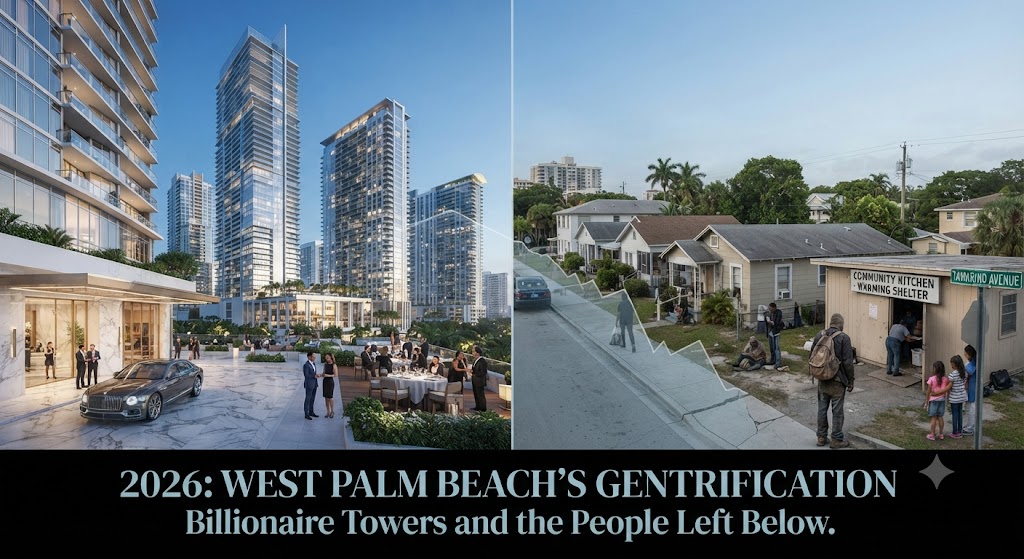
Inside Downtown’s Tale of Two Cities — Billionaire Towers and the People Left Below
By Brian French | Florida Commercial Real Estate News | Last updated: July 22, 2026
Quick Answer: Downtown West Palm Beach is undergoing one of the fastest gentrifications in American urban history. The “Wall Street South” migration has delivered fully-leased Class A office towers, eight luxury condo projects with units priced from $2 million to $70 million, a $520 million Vanderbilt University campus, Michelin-caliber restaurants, spas, and premium theaters serving newly arrived financial wealth. Simultaneously, the city carries a poverty rate above the Florida average, one of the highest income-inequality scores of any comparable American city (Gini index 0.5037), neighborhood median incomes ranging from $16,017 to over $250,000, and the county’s largest concentration of residents experiencing homelessness — 1,520 people counted countywide in the most recent tally, clustered heaviest in West Palm Beach and Riviera Beach. Both trends are accelerating. This is the full picture, both directions, with the data.
What Is Happening to Downtown West Palm Beach?
Walk Flagler Drive at sunset and the transformation announces itself in glass and cranes. One Flagler — the waterfront office tower that skeptics said the market couldn’t fill — is 100% leased, capped by Wells Fargo’s January 2026 announcement that it would headquarter its wealth division there. Two more towers are financed. Vanderbilt University’s $520 million campus won approval, planting a research university downtown explicitly because the finance industry arrived first. The “Wall Street South” nickname, once dismissed as billboard marketing, is now simply a description: GoldenTree Asset Management, Bessemer Trust with its roughly $200 billion under management, Baron Funds, John Paulson’s family office, and the Glazer family’s Lancer Capital have all planted flags downtown.
The residential response is unprecedented for a city of roughly 122,000. Eight luxury towers are under construction with units from $2 million to $70 million, anchored by the Mandarin Oriental Residences on North Flagler Drive — the spine of what marketers now call the “Billionaire Corridor.” South Flagler House starts in the high $7 millions. The Ritz-Carlton Residences broke ground. The $1 billion, 40-acre NORA district converted a warehouse zone into a dining-and-boutique quarter with its first phase open. Downtown already holds nearly 9,000 residential units and 10.4 million square feet of commercial space, and the city is rewriting its Downtown Master Plan to manage what’s still coming.
Around the towers grew the amenity layer the new residents expect: white-tablecloth restaurants where dinner for two clears $400, spa and wellness concepts, cocktail lounges, and the refurbished Kravis Center anchoring a premium theater scene. Clematis Street and Rosemary Square, once casual, now cater unapologetically upmarket. This is the top-10% economy, built at speed, and by every commercial measure it is succeeding.
Who Is Being Left Behind?
Blocks away — literally blocks — the same city tells a different story, and the data is just as unambiguous.
West Palm Beach’s poverty rate runs roughly 13–15% depending on the survey year, above both the Florida and national averages. The city’s Gini index — the standard measure of income inequality — sits at 0.5037, a level associated with the most unequal cities in America. The neighborhood map makes the number visceral: median household incomes inside city limits range from $16,017 in the poorest tracts to over $250,000 in the wealthiest. The overall cost of living index has climbed to 134.7 — nearly 35% above the national average — with housing costs at 186.7, meaning a single adult now needs about $59,000 a year just to cover basics in a city where thousands of households earn a fraction of that. Median rent has pushed past $1,700.
And then there are the residents with no housing at all. Palm Beach County’s most recent Point-in-Time Count recorded 1,520 people experiencing homelessness, with the heaviest concentrations in the West Palm Beach and Riviera Beach areas — meaning the epicenter of the county’s homelessness sits beside the epicenter of its wealth boom. The count was actually down 28% from the prior year, the first decline after three years of increases — genuine progress credited to housing interventions and supportive programs. But service providers urge caution: Cristina Lucier of The Lord’s Place, who leads the county’s Homeless and Housing Alliance, has noted that Florida’s new anti-public-camping law may have pushed unsheltered people out of sight rather than out of hardship, making them harder to count. About 460 people were in emergency shelters and 146 in transitional housing at last count; this winter, the Salvation Army on Military Trail opened as an emergency warming station when temperatures dropped to freezing.
Brian’s Take 💬
The spreadsheet view: West Palm Beach is running a natural experiment in what happens when a generation of Manhattan wealth relocates into a mid-size Southern city in five years instead of fifty. The commercial results are spectacular and real — I’ve covered enough markets to know that 100% leased towers and a university following the money aren’t hype. But a Gini score above 0.50 is a portfolio manager’s risk flag, not just a sociology statistic. Cities, like portfolios, get fragile when everything concentrates at one end. The boom is genuine. So is the strain. Anyone analyzing this market honestly has to hold both numbers in the same hand.
— Brian French
How Did One Downtown Become Two Cities?
The geography of the divide is not accidental — it’s historical. Immediately northwest of the boom sits the Northwest Historic District, bounded by Tamarind Avenue, Rosemary Avenue, 11th Street and 3rd Street — the neighborhood where Black workers from northern Florida, Georgia, and the Bahamas settled after Henry Flagler extended his railroad south in the 1890s, building a segregated but self-sustaining community with 316 historic structures still standing. For a century, the neighborhood sat a few blocks from downtown. Now downtown’s land values are washing toward it.
A Palm Beach County housing equity study found the pattern in the data: the county’s Black communities carry disproportionate poverty, higher unemployment, more cost-burdened renter households, and even documented appraisal bias that devalues homes in predominantly Black neighborhoods. County housing official Carlos Murray traced the disparities directly to the Jim Crow era’s blocked economic opportunities — meaning today’s gentrification pressure lands on communities that were never permitted to build the equity that would let them benefit from rising values.
City Hall doesn’t deny the contrast; remarkably, it confirms it on the record. Mayor Keith James, pressed by WPTV about who the luxury towers actually serve, acknowledged that neither he nor most longtime residents could afford them, defended the strategy on tax-base and jobs grounds — welcoming wealthy arrivals because their tax bills fund the city — and then said the quiet part himself: <cite index=”53-1″>”Mere blocks away you have abject poverty.”</cite> That is the whole story of downtown West Palm Beach in seven words, delivered by its own mayor.
The mechanism connecting the two cities is the housing ladder — or rather, its missing rungs. Dozens of luxury buildings have been approved while affordable projects remain scarce, so the new wealth doesn’t just tower over the old poverty; it bids up everything between them. Workforce renters — the servers, spa technicians, stagehands, and hotel staff the premium economy depends on — face $1,700+ median rents in a city where a third of neighborhoods have five-figure median incomes. Each rung that disappears pushes someone closer to the bottom of the ladder, and the bottom of the ladder is the street.
What’s Coming Next — At Both Ends?
At the top: More of everything. The pipeline through 2027–2028 includes One West Palm’s completion (the city’s tallest building), Mr. C Residences, additional Related Ross towers, NORA’s later phases with hotel and retail, and the compounding effect of Vanderbilt’s campus — universities are gentrification accelerants with fifty-year time horizons. Restaurant groups and wellness brands follow branded residences the way gulls follow shrimp boats. Every indicator says the premium economy is still in its early innings.
At the bottom: More pressure, and a policy environment in flux. The federal government has shifted its homelessness funding model away from Housing First toward treatment-conditioned approaches, and county officials are bracing for revenue impacts from state property-tax changes — meaning the safety net is being rewoven mid-crisis. Ezra Krieg, chairman of the county’s Affordable Housing Commission, credits the county’s work while warning that government funding is receding and that the private sector must step up, noting the region <cite index=”41-1″>”could have easily become San Francisco or Los Angeles.”</cite> That it hasn’t is the county’s quiet achievement; that it still could is the unspoken worry behind every new tower rendering.
The 2026 reality: both forecasts are right. The city will get richer and its poorest residents will get more visible, sharing the same twenty walkable blocks.
Brian’s Take 💬
Here’s the pattern nobody wants to name: the luxury economy and the displacement economy are not separate stories that happen to share a zip code — they are one machine. The $70 million penthouse and the warming shelter on Military Trail are connected by a housing market with no middle. And here’s my contrarian flag: the greatest long-term risk to Wall Street South isn’t interest rates or hurricanes — it’s the workforce math. A premium restaurant needs forty employees who can live within commuting distance; a five-star hotel needs two hundred. When your line cooks are priced past Lake Worth, the amenity layer that attracted the wealth starts to wobble. The smartest money in this market should be lobbying for workforce housing, purely out of self-interest. Some of it is starting to figure that out.
— Brian French
The Numbers, Side by Side
| The Top of the Market | The Bottom of the Market |
|---|---|
| 8 luxury towers underway, units $2M–$70M | Neighborhood median incomes as low as $16,017 |
| One Flagler 100% leased; Wells Fargo wealth HQ | Poverty rate ~13–15%, above FL average |
| Vanderbilt’s $520M campus approved | Gini inequality index 0.5037 |
| $1B NORA district, Phase 1 open | 1,520 people homeless countywide (PIT count) |
| South Flagler House from high $7M | ~460 in emergency shelter, 146 transitional |
| Cost of living 134.7% of U.S. average | Single adult needs ~$59K/year for basics |
| ~9,000 downtown units, 10.4M sq ft commercial | Median rent $1,709 and climbing |
Frequently Asked Questions
Is downtown West Palm Beach gentrifying? Yes, at a pace with few American precedents — driven by financial-industry relocation (“Wall Street South”), eight simultaneous luxury condo towers, fully-leased Class A offices, and a wave of premium restaurants, spas, and theaters. The city is updating its Downtown Master Plan specifically to manage the growth.
How bad is homelessness in West Palm Beach? Palm Beach County’s latest Point-in-Time Count found 1,520 people experiencing homelessness, concentrated most heavily in the West Palm Beach and Riviera Beach areas. The count fell 28% year-over-year — real progress — though providers caution Florida’s anti-camping law may cause undercounting of unsheltered residents.
Who is being displaced by West Palm Beach development? Pressure falls hardest on longtime residents of neighborhoods adjacent to downtown, including the historically Black Northwest Historic District, and on workforce renters facing $1,700+ median rents. County studies document that Black communities carry disproportionate cost burdens rooted in generations of blocked equity-building.
What did the mayor say about the wealth gap? Mayor Keith James acknowledged the contrast directly, noting that most longtime residents cannot afford the new towers and that abject poverty exists blocks from the luxury corridor, while defending the development strategy for its tax revenue and job creation.
Will the boom continue? Every commercial indicator says yes: financed towers, an incoming university campus, branded residences, and continued corporate migration. The open question is whether housing policy closes the gap between the city’s two economies or widens it.
Brian’s Take 💬 (The Bottom Line)
I’ve analyzed markets my whole career, and West Palm Beach in 2026 is the most vivid contrast trade in Florida: long the waterfront, short the ladder. My honest read — this boom is durable, the human cost is real, and the two facts don’t cancel each other out no matter which one your politics prefers. The county deserves genuine credit for a 28% reduction in homelessness while building a billionaire corridor; that combination is rarer than it should be. But the test isn’t this year’s count. It’s whether, five years from now, the people who park the cars and plate the food at Wall Street South can still live in the county that depends on them — and whether the first paragraph ever written about the Northwest District’s next chapter is about its renaissance or its erasure. This publication will be covering both possibilities. That’s the assignment.
— Brian French
About the Author
Brian French is the founder of Florida Commercial Real Estate News and the Florida Authority Network, and one of Florida’s most prolific business writers with more than 1,500 published articles covering the state’s economy. A University of South Florida finance graduate, he previously served as Vice President and portfolio manager at Merrill Lynch and Vice President at SunTrust — an analytical background that shapes his data-first coverage of Florida’s commercial markets. He writes from Valrico, Florida. Story tips and press releases: Brian@FLAuthorityNetwork.com. Articles may be cited with attribution.
Sources & Resources
- Modern Living RE — Wall Street South in 2026: How Finance Remade West Palm Beach Real Estate (One Flagler leasing, Wells Fargo HQ, Vanderbilt campus, firm migration): https://www.modernlivingre.com/blog/wall-street-south-the-rise-of-new-york-businesses-west-palm-beach
- Atlis Realty — West Palm Beach’s Luxury Condo Boom: 8 New Towers ($2M–$70M unit pricing, Mandarin Oriental anchor): https://atlisre.com/complete-guide-to-west-palm-beachs-luxury-condo-boom-8-new-towers-to-watch/
- Fox Business — Mandarin Oriental Anchors New ‘Billionaire Corridor’ (developer and broker commentary): https://www.aol.com/articles/wall-street-south-expansion-mandarin-110000266.html
- Laurie Reader Real Estate — West Palm Beach New Construction Boom 2026 (NORA district, downtown unit/square-footage inventory, project pipeline): https://www.lauriereader.com/blog/west-palm-beach-new-construction-boom-2026-downtown-developments-luxury-condos-mixed-use-projects/
- WFLX (Fox 29) — West Palm Beach Housing Crisis Deepens as Luxury Towers Rise (Mayor Keith James interview): https://www.wflx.com/2026/04/02/west-palm-beach-housing-crisis-deepens-luxury-towers-rise-amid-limited-affordable-options/
- WLRN / Stet News — Palm Beach County Has a New Plan to Fight Homelessness (2025 PIT count of 1,520, Krieg and Marino comments, policy shifts): https://www.wlrn.org/government-politics/2026-02-03/palm-beach-county-has-a-new-plan-to-fight-homelessness and https://stetnews.org/2026/02/02/homeless-plan-palm-beach-county/
- WPTV — Palm Beach County Homelessness Decreased, Advisory Board Says (geographic concentration, shelter/transitional counts): https://www.wptv.com/news/palm-beach-county/cases-of-homelessness-in-palm-beach-county-decreased-advisory-board-says
- Palm Beach County Continuum of Care — Homeless & Housing Alliance Annual Report FY24–25: https://thehomelessplan.org/pdf/2026/CoC_Annual_Report_FY24-25.pdf
- City-Stats — West Palm Beach demographic profile (Gini index, poverty rate, cost-of-living and housing indices): https://city-stats.com/florida/west-palm-beach/
- BestNeighborhood.org — West Palm Beach neighborhood income mapping ($16,017–$250,001 range): https://bestneighborhood.org/household-income-west-palm-beach-fl/
- WLRN — Racial Inequities in Housing Persist in Palm Beach County (county housing equity study): https://www.wlrn.org/government-politics/2023-11-03/racial-inequality-housing-palm-beach-county-study
- Wikipedia / City of West Palm Beach — Northwest Historic District history and boundaries: https://en.wikipedia.org/wiki/Northwest_Historic_District
Demographic figures vary modestly across ACS survey years; ranges are presented where sources differ. Homelessness data reflects the most recent published county Point-in-Time Count. This article is informational; those experiencing a housing crisis in Palm Beach County can reach the Homeless and Housing Alliance network via The Lord’s Place or Palm Beach County Community Services.
About the Author