The Two-Boat Problem: A Buyer’s Analysis of Trading Up in West Palm Beach’s $4.7 Billion Marine Economy
By Brian French | Florida Marine News — Independent editorial content
Brian French is a former Vice President and Portfolio Manager for Merrill Lynch Private Investors and Trust Investment Officer for SunTrust Bank, and a University of South Florida finance graduate. He covers Florida’s waterfront economies for the Florida Authority Network.
Trading up in boats is the only major purchase most people make where the showroom, the trade-in lot, the mechanic, the parking space, and the financing all live in one ecosystem — and where that ecosystem, not the buyer, holds most of the cards. The industry calls it “moving up.” An analyst would call it what it really is: a two-sided transaction executed inside a supply-constrained local market, where you must simultaneously exit one vessel and enter another, and where the quality of your outcome depends less on negotiating skill than on understanding the market’s structure before you start.
Few boating markets in America can actually be understood that way, because few publish their numbers. Palm Beach County does. Between the economic impact work commissioned by the Marine Industries Association of Palm Beach County, the tri-county studies from the Marine Industries Association of South Florida, and the Business Development Board’s industry summaries, the West Palm Beach marine economy is documented to a degree most industries would envy. This article puts that public record to work on one specific question: if you own a boat in the 40-to-50-foot class and intend to own something in the 55-to-70-foot class, what does the data say about the market you’re about to transact in — twice?
What Kind of Market Are You Actually Entering?
A large one that behaves like a small one. The Murray & Associates research commissioned by the county’s marine association measures the industry’s total annual economic impact at $4.7 billion within Palm Beach County alone, supported by roughly 22,000 workers. Fold in Broward and Miami-Dade and the 2022 regional study finds an $18.5 billion tri-county marine economy employing about 141,000 people, within a state whose marine-related sales of $7.19 billion represent roughly 38% of the national market. By economic weight, Southeast Florida is to recreational boating approximately what Houston is to energy.
Yet the structure underneath those billions is intimate. The Business Development Board counts 204 marine-industry companies operating in Palm Beach County. The county’s registered fleet numbers about 37,000 vessels. The entire inventory of wet slips carries a combined market value of $436 million, and the county’s marinas and boatyards together appraise at $78.4 million. Those are not the statistics of an anonymous mass market; they’re the statistics of a professional community where the brokers know the yards, the yards know the boats, and — by the time you’re shopping at 60 feet — everyone will shortly know you.
Palm Beach County’s Marine Economy at a Glance
| Measure | Value | Source |
|---|---|---|
| Annual county economic impact | $4.7 billion | MIAPBC / Murray study |
| County marine employment | ~22,000 jobs | MIAPBC |
| Marine companies in county | 204 | Business Development Board of PBC |
| Registered vessels, county | ~37,000 (up ~3% between study periods) | Murray 2022 |
| Combined market value, county slips | $436 million | Business Development Board of PBC |
| Appraised value, marinas/boatyards | $78.4 million | Business Development Board of PBC |
| Service sector share | >50% of impact; $1B+ sales; 9,885 jobs | Business Development Board of PBC |
| Tri-county impact / employment | $18.5 billion / ~141,000 | MIASF 2022 |
| Boat show statewide impact | $1.05 billion | MIAPBC |
Brian’s Take: The most useful thing a move-up buyer can do with these numbers is recalibrate what they’re negotiating. In a 204-company town, you are not an anonymous customer extracting the best deal from strangers — you are entering a reputation network you’ll transact with for a decade: the broker on this deal is the broker on your next one, and the yard you squeeze on price this year schedules you accordingly next year. Big-market economics, small-market relationships. Price matters; standing matters more. I ran private-client money long enough to know which one compounds.
Why Is the Hardware Under the Water the First Thing to Check?
Because at the next size class, physics starts voting. A 45-footer forgives; a 65-footer with five-plus feet of draft and a wide beam needs specific depths, specific fairway widths, and honest deepwater access to open ocean. West Palm Beach’s structural answer is the Lake Worth Inlet — the deepwater cut that also serves the Port of Palm Beach, Florida’s fourth-busiest container port and eighteenth in the nation — giving recreational traffic an ocean passage without bridge negotiations or thin water.
The proof of what the local hardware supports sits just south of the inlet. Safe Harbor Rybovich, the yard founded in 1969 and folded into the Safe Harbor Marinas network in 2020, berths vessels up to 100 meters — 328 feet — on floating docks with 18-foot approach and dockside depths, backed by more than 20 acres of service campus in West Palm Beach and additional Riviera Beach facilities that include a floating dry dock rated for yachts up to 90 meters. When the local flagship facility is engineered for boats five times the length of the one you’re buying, your 60-footer is not a stretch for this market’s infrastructure. It’s mid-sized.
There’s a subtlety in the facility data worth a buyer’s attention, though: capability and capacity are different things. Directory listings for Rybovich record a slip count in the dozens — Waterway Guide logs 60 slips, 20 of them transient — and that top-heavy pattern repeats across the county’s premium waterfront: extraordinary engineering, boutique inventory. The county can handle your bigger boat anywhere. Whether it has a space for it where you want one is a separate question, which brings us to the money.
Brian’s Take: Draft is destiny. Before you shortlist a single hull, take your target size class and map which county facilities can physically berth and haul it — depth, beam, travel-lift or dry-dock capacity — because that map, not the brokerage listings, is your real menu. I’ve seen buyers work a purchase for six months and discover in week twenty-five that their dream slip takes their dream boat’s length but not its draft at low tide. Do the physics first. It’s a two-hour exercise that reorders everything after it.
What Does the Dockage Market Look Like From the Buyer’s Side?
Like waterfront real estate, because that’s what it is. The arithmetic is stark when you set the two headline figures side by side: roughly 37,000 registered vessels in the county, and a total slip inventory whose market value — $436 million — is a rounding error against the value of the boats seeking it. Registrations grew about 3% between the Murray study periods; protected Intracoastal frontage grew 0%. Every foot of length you add narrows the subset of slips that fit you and deepens the pool of large-yacht competition you share them with, up to and including vessels whose owners think of dockage costs the way you think of ice.
And this market prices accordingly — which is to say, opaquely. Premium facilities in the county quote dockage individually rather than posting rate cards; the scattered figures that surface in marina directories age fast (one logged a transient rate of $3.75 per foot per day at Rybovich as far back as 2019, a number useful today only as a historical floor). Opacity plus scarcity equals pricing power, and the practical translation for a buyer is that dockage should be treated as a negotiated, written, early component of the acquisition — quoted for your specific length, beam, draft, and power draw — never as an errand for after the closing.
One more line from the studies rounds out the ownership picture: Murray’s research measured boater spending at about $52.97 per outing on incidentals alone — fuel, provisions, ice — which aggregates to roughly $91 million in county retail annually before a single yard invoice or slip payment. Small number, big signal: this is an economy built on owners who spend continuously, and its vendors have calibrated to that customer.
Brian’s Take: In every asset class I’ve worked, the scarce complement rules the abundant asset — land over houses, spectrum over handsets, and here, slips over boats. There will always be another 60-footer for sale; there will not always be an available berth that fits it where you actually want to keep it. So invert the standard search: qualify the dockage first, in writing, then shop hulls that fit the berth. Buyers who sequence it that way negotiate the boat from strength. Buyers who sequence it backwards negotiate the slip from desperation — and the slip side knows it.
Who’s Going to Take Care of the Thing?
This is where Palm Beach County’s data delivers its most reassuring answer — and its most underrated warning. The Business Development Board’s summary of the impact research finds that more than half of the county’s entire marine economic output comes from the service sector: over $1 billion in annual business sales, $369 million in personal income, and 9,885 jobs among the technicians, electricians, riggers, painters, canvas makers, captains, and yard crews who keep the fleet operational. Read that composition again: in this county, fixing and maintaining boats is a bigger business than selling them.
For the move-up buyer, that’s the whole ballgame. The step from 45 to 60 feet is less a change in size than a change in systems count — generators, stabilizers, watermakers, integrated electronics, hydraulics — and a corresponding change in your dependence on skilled labor you don’t personally supervise. A market with 9,900 service professionals and world-class refit anchors is a market where competence is never the question. Availability is. You share this labor pool with a superyacht clientele whose projects book yards months out and whose budgets set the prevailing rates; the honest folklore of every large-boat dock in the county is that the difference between a good ownership year and a bad one is whether your service manager returns your calls in season.
What the public data honestly cannot give you is a cost table — no credible published source prices annual ownership at a given length in this county, and the percentage-of-hull-value heuristics that circulate on forums are campfire math. The studies give you direction instead: an economy whose center of gravity is service is an economy where the after-purchase spend is the main event. Budget like it.
Brian’s Take: Here’s the reframe I’d give a client: at 60 feet you are no longer buying a product, you’re hiring a staff — you just pay them through invoices instead of payroll. So conduct the move-up like a hiring process. Before you close, interview two yards and a service manager the way you’d interview a wealth advisor: ask who does their electrical, what their season lead times run, who they’d assign to a boat like yours. The buyers who struggle here didn’t pick the wrong boat; they showed up with no relationships in a relationship market. Staff first. Boat second.
How Do You Run the Two Transactions — Sell and Buy — on One Calendar?
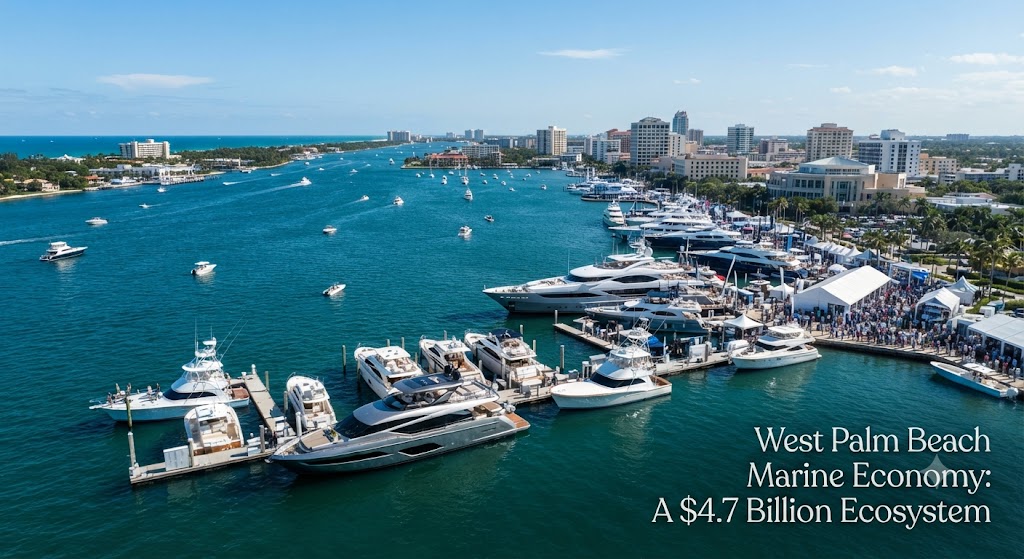
Around the market’s annual heartbeat. Every March, the Palm Beach International Boat Show takes over the Flagler Drive waterfront downtown — one of the five largest boat shows in the United States, drawing more than 55,000 attendees and generating a statewide economic impact the county’s marine association puts at $1.05 billion. For four days, the entire ecosystem this article has described — brokers, builders, yards, insurers, lenders, dockmasters — is walking distance from itself.
The move-up buyer’s mistake is treating the show as a store. Its real function in your year is as the market’s liquidity event and intelligence window, on both sides of your two-boat problem. On the sell side: show season concentrates buyer attention statewide, which argues for having your current boat surveyed, refreshed, and listed into that attention rather than after it fades. On the buy side: the show is where you calibrate the target class hands-on, meet the brokers worth keeping, and — most valuably — conduct the unglamorous infrastructure meetings this article keeps insisting on: the dockage conversations, the yard introductions, the insurance quotes for the bigger hull. Then let the calendar work for you: the months after the show reliably contain sellers whose boats drew crowds and no contracts.
Sequenced against everything above, the disciplined move-up year looks like this: physics map and dockage qualification in the fall; current boat prepped over the winter; show attendance in March for calibration and relationships; sell into show-season demand; negotiate the purchase in the post-show months with slip and service relationships already secured; commission and shake down before the next season. Twelve months, two transactions, zero desperation.
Brian’s Take: Every market with one dominant annual event develops a predictable emotional cycle — euphoria at the event, hangover after — and disciplined participants trade against the cycle rather than inside it. Sell into the enthusiasm; buy into the hangover. It worked in every asset class I ever managed and it works on Flagler Drive. The only part of the plan that can’t be timed is the relationship-building, which is why it starts first. Deals are seasonal. Standing is permanent.
The Bottom Line
Palm Beach County will support your bigger boat better than almost any market in America — that’s what $4.7 billion, 22,000 marine workers, a majority-service economy, and 100-meter-rated infrastructure mean in plain terms. But the same public record maps exactly where the leverage sits: in scarce, opaquely priced dockage; in a shared, superyacht-calibrated labor pool; and in an annual market rhythm that rewards sellers in March and buyers in the months after. The move-up is a two-boat, twelve-month, relationship-driven project conducted inside someone else’s supply constraints. Run it in the right order — physics, slip, staff, sale, purchase — and the county’s depth works entirely for you.
Frequently Asked Questions
Is West Palm Beach a good place to keep a 60-foot yacht? Structurally, yes — deepwater ocean access via the Lake Worth Inlet, facilities engineered well beyond that size class (Safe Harbor Rybovich berths vessels to 328 feet at 18-foot depths), and a county service sector of nearly 9,900 marine workers. The constraint is slip availability at that length, which should be secured in writing before or alongside the purchase.
How big is the marine industry in Palm Beach County? $4.7 billion in annual economic impact and roughly 22,000 jobs, per the Marine Industries Association of Palm Beach County’s commissioned studies, within an $18.5 billion tri-county marine economy employing about 141,000 people.
Should I sell my current boat before buying the bigger one? In this market, sequence both around the March boat show: list and sell into show-season demand, then buy in the post-show months when unsold inventory motivates sellers — with your dockage and service relationships arranged before either transaction closes.
What does dockage cost in West Palm Beach? Premium facilities quote individually rather than publishing rates, and directory figures date quickly — a 2019 listing recorded transient dockage at $3.75 per foot per day at the county’s flagship facility, useful now only as a historical reference. With county slip inventory valued at $436 million against ~37,000 registered vessels, expect meaningful pricing power on the marina side and negotiate written terms early.
When is the Palm Beach International Boat Show? Late March each year, along Flagler Drive in downtown West Palm Beach — among the five largest U.S. boat shows, with 55,000+ attendees and an estimated $1.05 billion statewide economic impact.
Sources
- Marine Industries Association of Palm Beach County, “Industry Impact” (economic impact study by Thomas J. Murray & Associates) — marinepbc.org/industry-impact
- Thomas J. Murray & Associates, Inc., “Recent Growth and Economic Impact of the Recreational Marine Industry in Southeast Florida’s Tri-County Region — 2022” — marinepbc.org
- Business Development Board of Palm Beach County, “Marine Industries” — bdb.org/industries/marine-industries
- Marine Industries Association of South Florida, “Economic Impact of the Recreational Marine Industry — Broward, Miami-Dade, and Palm Beach Counties” — miasf.org/about/library
- Safe Harbor Marinas, “Safe Harbor Rybovich” — safeharbor.com/locations/safe-harbor-rybovich; facility specifications via Waterway Guide
- Marine Industries Association of Palm Beach County, Palm Beach International Boat Show economic reporting — marinepbc.org
Independent editorial content of Florida Marine News, a Florida Authority Network publication. This is market analysis, not purchase, financial, insurance, or legal advice; engage qualified marine professionals, surveyors, and advisors before any transaction. Figures reflect the cited studies as of their publication dates.
About the Author