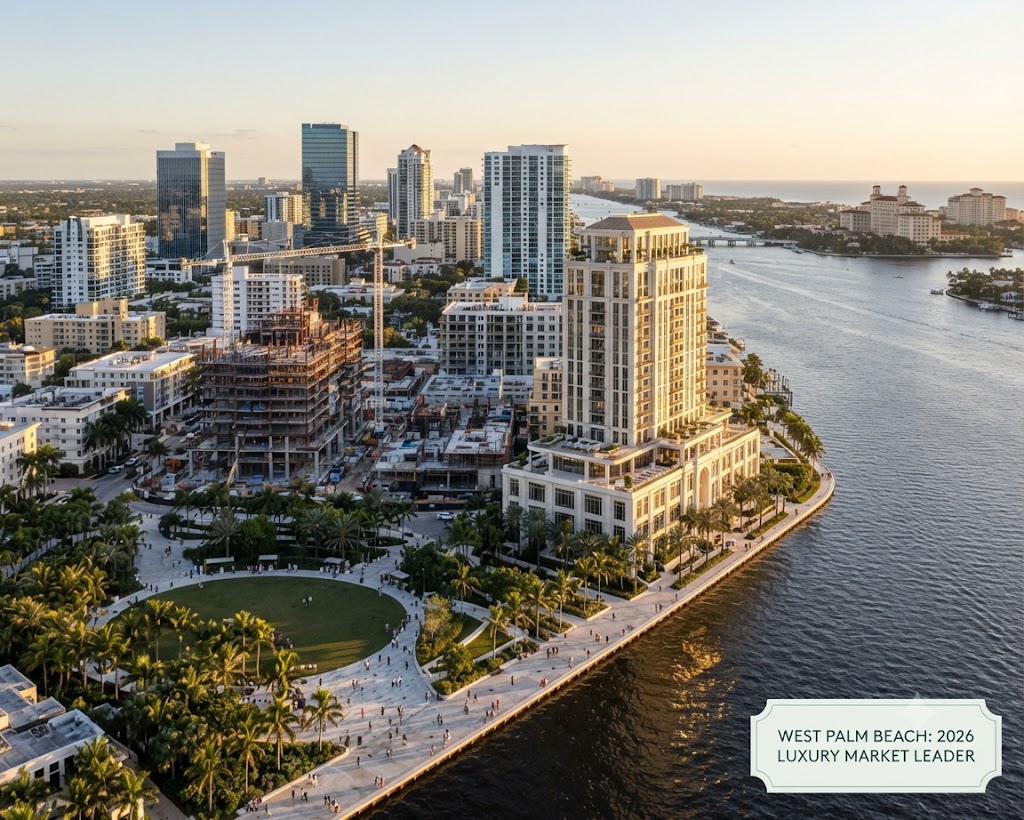
The State of the 2026 Luxury Residential Real Estate Market in West Palm Beach, FL
Quick Answer: West Palm Beach enters mid-2026 as the hottest luxury housing market in America. The metro’s median luxury sale price hit $4.2 million (up 10.7% year over year) — more than double the national luxury gain — while luxury pending sales surged 30%, the largest increase of any major U.S. metro, according to Redfin’s early-2026 analysis. Over the past decade, West Palm Beach luxury prices have soared 187%, more than any other major American metro, making it the sixth most expensive metro in the country to buy a luxury home. Demand is powered by the “Wall Street South” wealth migration; supply is defined by a historic new-construction wave — South Flagler House (with sales above $70 million per unit), the Ritz-Carlton Residences, Shorecrest, and Edgeworth — even as older condo stock quietly corrects under insurance and post-Surfside cost pressures. The 2026 story, in one word: bifurcation.
West Palm Beach Luxury Market: 2026 Key Metrics
| Metric | Figure |
|---|---|
| Median luxury sale price (metro, early 2026) | $4.2 million (+10.7% YoY) |
| Luxury pending sales (YoY) | +30% — highest of any top-50 U.S. metro |
| 10-year luxury price appreciation | +187% — most of any major metro |
| National luxury-price rank | 6th most expensive metro (behind 4 CA metros + Miami) |
| Luxury new listings (YoY) | −4.3% (supply tightening) |
| Citywide median sale price (March 2026) | ~$527,000 (+10.9% YoY) |
| Cash purchases (Palm Beach County, late 2025) | ~47–48% of transactions |
| Record new-construction benchmark | South Flagler House sales above $70 million per unit |
Why Is West Palm Beach the Nation’s Hottest Luxury Market?
The demand side is by now a familiar story to readers of this series: the “Wall Street South” migration keeps delivering exactly the buyers luxury housing needs. Hedge funds, private equity firms, and family offices relocating from New York, Connecticut, and California bring principals and partners who buy $3–30 million residences the way other markets absorb starter homes — and increasingly they’re joined by the executives of the city’s new corporate arrivals, from ServiceNow’s incoming AI hub to the fintech cluster downtown. Florida’s zero state income tax remains the migration’s engine; a brutal northern winter was its 2026 accelerant, with local agents reporting vacationers converting into buyers in real time.
What’s changed is the market’s identity. West Palm Beach is no longer priced as Palm Beach Island’s spillover — analysts now describe it as a standalone luxury brand, with international buyers and branded-residence developers (Ritz-Carlton, Banyan Tree) treating the city’s Intracoastal waterfront as a destination in its own right. The comparison with the island remains instructive: Palm Beach proper still trades at another altitude (Q4 2025 single-family sales averaged roughly $15.3 million at ~$3,040 per square foot), but that gap is precisely what makes West Palm Beach’s $600–1,000+ per square foot waterfront product feel, to relocating wealth, like value.
What Do the 2026 Numbers Actually Show?
Peel the data apart and the market’s structure comes into focus. The top 5% is on fire: a $4.2 million median luxury price, up 10.7% year over year, with pending sales up 30% while luxury new listings fell 4.3% — rising demand meeting shrinking supply, the textbook formula for further appreciation. Sotheby’s Q4 2025 community data shows the same shape from a different angle: while roughly 77% of West Palm Beach closings remained under $1 million, the $1–3 million and $3 million-plus tiers posted outsized year-over-year gains — the high end is where the market’s energy lives.
The buyer profile explains the resilience. Nearly half of Palm Beach County transactions close in cash (approaching 48% in late 2025, higher still in condos), insulating the luxury segment from mortgage-rate gravity that governs ordinary markets. Turnkey, well-positioned properties are moving faster than historical averages, and pricing power sits firmly with sellers of anything new, waterfront, or both. Meanwhile the broader city market tells a steadier story — a ~$527,000 citywide median, up 10.9% — confirming that the luxury boom sits atop a generally healthy, if far less dramatic, base.
By tier, brokers now describe a clearly stratified ladder: entry luxury (well-positioned resales and newer condos) at roughly $900,000–$1.5 million; mid-tier waterfront, especially along Flagler Drive, at $1.5–4 million; and new-development penthouses and ultra-luxury running well past $5 million, with select trophy residences exceeding $10 million — and, at the very top of the new-construction pyramid, far beyond.
📌 Brian’s Take — Reading the Numbers
Three statistics tell you everything: +30% pending sales, −4.3% new listings, 48% cash. That’s demand accelerating into shrinking supply among buyers who don’t care what the Fed does. When I evaluate whether a luxury market is momentum or mania, I look for leverage — and there’s remarkably little of it here. This boom is being paid for with realized gains, not borrowed money, which is why it shrugged off the rate environment that froze luxury markets elsewhere. The one number I’d caution sellers about: 187% appreciation in a decade means the easy money has been made. From here, returns come from picking the right product — and as I’ll explain below, in 2026 the market is punishing the wrong product severely.
The New-Construction Wave: What’s Setting the Prices
The defining feature of 2026 is a development pipeline unlike anything in the city’s history — profiled in this series’ commercial real estate guide and summarized here through a residential lens.
South Flagler House is the benchmark that re-rated the entire market: Related Ross’s $600 million, Robert A.M. Stern-designed condominium on the Intracoastal has topped off with reported sales above $70 million per unit — pricing that simply did not exist on the West Palm side of the water before, and that instantly repriced every waterfront parcel in the city. The Ritz-Carlton Residences breaks ground in early 2026 (targeting 2027) with an Olympic-size pool, spa, and a private residential marina — the first five-star branded-residence flag of this scale in the city. Shorecrest, a 28-story, 98-unit tower at 1865 North Flagler backed by a $157 million construction loan closed in February 2026, brings Equinox-managed amenities to the north waterfront in 2027. The two-tower, 168-unit Edgeworth launched sales in March 2026 at 1155 South Flagler; Related Ross paid $55 million in May for a full downtown block to build yet another 100–130-unit condo; and beyond the Ross portfolio, projects like The Berkeley (marketing the city’s largest waterfront balconies), Alba Palm Beach in Northwood (the only new tower with private dockage and direct Intracoastal boat access), and the multi-phase Northwood Marina Quarter (NOMAR) with Huizenga Holdings and GL Homes extend the map northward.
Geographically, the hierarchy is stable: Flagler Drive is the market’s Park Avenue — limited parcels, direct water views across to Palm Beach Island, relentless competition. Downtown around CityPlace and Clematis trades on walkability and the new-tower skyline; the South End (SoSo) offers quieter residential character minutes from both; and Northwood is the emerging-value play, where the boat-access premium and NOMAR’s long-term vision are pulling luxury dollars into a formerly overlooked corridor.
The Other Half of the Story: The Bifurcation
An honest 2026 report must include what the headline numbers hide: this is two markets wearing one zip code. While new waterfront product sets records, older condominium stock is quietly correcting — one inventory tracker showed the city’s median condo list price actually declining year over year even as house and land prices jumped. The causes are structural, not cyclical. Post-Surfside safety legislation requires milestone inspections and fully funded reserves, hitting owners of 30-to-50-year-old buildings with special assessments that can reach six figures per unit. Insurance premiums, though stabilizing from the chaos of recent years, remain far above national norms and weigh heaviest on older buildings without impact windows, modern roofs, and updated systems. And new federal FinCEN anti-money-laundering rules now require enhanced ownership and funding documentation on all-cash luxury purchases — a meaningful friction in a market that’s half cash, and one more reason transactions favor well-advised, well-prepared buyers.
The result, as one South Florida analyst put it, is price divergence, not a crash: scarcity-driven waterfront and new construction holding or rising while dated, assessment-burdened condos reprice downward. For buyers, that divergence is the opportunity and the trap in equal measure — building-level due diligence (reserves, HOA health, inspection status, insurance costs) now matters more than neighborhood-level averages.
📌 Brian’s Take — The Bottom Line for 2026
My framework for this market: buy the water, the new, or the story — and underwrite everything else like a forensic accountant. The water (Flagler frontage) is irreplaceable; the new (post-2020 construction) carries none of the assessment and insurance baggage; the story (Northwood/NOMAR, the emerging districts) is where appreciation upside still exists at sub-peak pricing. What I’d avoid: 40-year-old condo stock priced off 2022 comps, where sellers haven’t yet accepted that reserve mandates changed their asset’s value. And a prediction: watch what happens when Vanderbilt’s campus and the ServiceNow hub start hiring in earnest — the sub-$2 million “luxury-lite” tier serving well-paid professionals (not just principals) is the segment I expect to outperform through 2028. The $70 million penthouse gets the headlines; the $1.4 million two-bedroom near the office towers gets the volume.
The Outlook
Every leading indicator points to continued strength at the top: pending sales momentum, shrinking luxury inventory, a construction pipeline pre-selling at record prices, and a demand engine — tax migration, corporate relocation, and now a university and an AI hub — that keeps compounding. The risks are the ones this series keeps flagging honestly: insurance costs, affordability strain on the workforce that serves the luxury economy, the aging-condo overhang, and the sheer concentration of the pipeline in one developer’s hands. But in 2026, West Palm Beach’s luxury residential market has achieved something rarer than a boom: it has achieved escape velocity from its old identity. The city across the bridge from Palm Beach is no longer the affordable alternative. It’s the destination.
Frequently Asked Questions
How much does a luxury home cost in West Palm Beach in 2026? The metro’s median luxury sale price is about $4.2 million (top 5% of the market). Practical tiers: entry luxury from roughly $900K–$1.5M, mid-tier waterfront $1.5–4M, new-development penthouses $5M+, with trophy new construction like South Flagler House recording sales above $70 million.
Is West Palm Beach luxury real estate a good investment in 2026? The top tier shows exceptional momentum (+30% pending sales, −4.3% new listings, 187% decade-long appreciation), but the market is bifurcated: new and waterfront product is appreciating while older condos face assessment and insurance headwinds. Building-level due diligence is essential, and past performance doesn’t guarantee future results — consult licensed local professionals.
Why are prices rising so fast? A cash-rich buyer migration (Wall Street South), scarce waterfront land, falling luxury inventory, and record-setting new construction that re-rates surrounding values.
What’s the biggest risk in the market? For older condos: post-Surfside reserve/inspection mandates and insurance costs driving special assessments. For the market broadly: affordability strain, insurance, and heavy reliance on continued wealth migration.
References and Sources
- Redfin News — “West Palm Beach’s Luxury Housing Market Is Booming, With Sales Up 30%” (March 2026): $4.2M median, +10.7%, +30% pending sales, 187% decade appreciation, listing declines. https://www.redfin.com/news
- Redfin — West Palm Beach Housing Market data (March 2026 citywide median ~$527K, +10.9%). https://www.redfin.com
- Greg Forest Group / Sotheby’s & MIAMI Association data — “Palm Beach vs West Palm Beach Market: 2026 Luxury Data” (Q4 2025 tiers, cash share ~47–48%, island comparison, post-Surfside condo dynamics). https://gregforestgroup.com
- Lux Life Miami (David Siddons Group) — “West Palm Beach Real Estate Market 2026” (bifurcation/price divergence analysis, standalone luxury brand thesis). https://luxlifemiamiblog.com
- Beachway International Realty — “Inside West Palm Beach’s Luxury Real Estate Boom: 2026 Market Guide” (branded residences, FinCEN compliance, buyer conditions). https://beachwayinternational.com
- The Berkeley Palm Beach — 2026 buyer market analysis (price tiers, neighborhood hierarchy). https://www.theberkeleypalmbeach.com
- Forbes (Brad Hunter) — “What Is Driving the Explosion of Development in West Palm Beach?” (April 2026): South Flagler House, Ritz-Carlton Residences, NOMAR, Alba. https://www.forbes.com
- Commercial Observer — Related Ross residential financings: Shorecrest $157M (Feb. 2026), Edgeworth launch, $55M block purchase (May 2026). https://commercialobserver.com
Market statistics reflect published reports as of mid-2026 and rolling data periods as noted; real estate conditions change quickly, figures vary by data provider and boundary definitions, and nothing here is investment advice — verify current data and consult licensed professionals before transacting.
About the Author